
A Winter Song by Walther von der Vogelweide
Winter can still be quite uncomfortable for us today. In earlier times, however, it could be life-threatening for people. A poem by the medieval minstrel Walther von der Vogelweide bears witness to this.
[Winter]1
The world shone brightly, yellow, red and blue,
The forest and its siblings
were dressed in verdant garments,
the little birdies sang their songs.
But now only the hooded crow cries out.
Hasn’t the colour changed too? Of course it has!
Pale is the world, pale and grey,
painting worry lines on our foreheads.
In summer, I was enthroned on a green hill,
with flowers sprouting and fragrant clover
between me and a lake.
What a delight for the eyes!
But where we once wove wreaths of flowers,
now everything is covered in hoarfrost and snow,
much to the chagrin of the little birds.
The foolish cry: „Let it snow!“
But poor people: „Oh woe! Oh woe!“
So a leaden gloom depresses me,
winter’s sorrow weighs heavy on me.
But all the miserable lamentations
would quickly vanish from my lips,
if only summer returned at last.
To no longer have to live like this,
I would even eat raw crayfish.
Summer, make us happy again!
Give the woods and meadows back their ornaments!
In your arms I played with the flowers,
my soul was soaring in the sun –
now winter has chased it into the straw.
I am as chafed as Esau2 from lying down so much,
my straight hair has become all shaggy.
Sweet summer, where have you gone?
How I’d love to watch you working in the fields!
If this melancholy keeps me in its clutches,
I’d rather be a monk in Doberlug3.
Walther von der Vogelweide: [Winter] (Middle High German)
Version in New High German on LiteraturPlanet.de
Musical Setting by Qntal (comprises the first three stanzas)
from: Qntal V: Silver Swan (2006)
Annotations:
- The special musicality of the poem is manifested, among other things, in the fact that the rhymes of each stanza end in a different vowel in Middle High German. Since an analogue translation into English could diminish the poetic power of the text, the adaptation concentrates more on the semantic level.
- Esau: Esau literally means „the hairy, the shaggy one“. According to the Old Testament, his whole body was „reddish“ and like a single „hairshirt“ – which fits well with the hibernal neglect described by Walther (cf. bibelkommentare.de).
- Doberlug: The reference is to the Cistercian monastery of Dobraluh (Dobrilugk), founded in 1165, today Doberlug-Kirchhain (Brandenburg). By making the seclusion of the monastery walls – the opposite of the ideal life for a life-loving minstrel – appear as a possible place of refuge, the perceived desolation is additionally emphasised.
Winter – Past and Present
Even for modern people, winter still holds many inconveniences in store. Slippery roads, flu epidemics, nasty winds, strenuous snow clearing, avalanches, „snow chaos“ – there are still many things that make winter unpopular today.
Overall, however, we have managed to tame winter. It has long ceased to be an unpredictable predator for us. We even play with it on the ski slopes and toboggan runs, and if it hisses too much, we simply retreat to our cosy warm homes. Only those who live on the fringes of civilisation still face an existential threat in winter. The same applies to those who deliberately expose themselves to the elemental force of winter, for example on polar expeditions or mountain tours into the eternal ice.
In former times, however, winter was always potentially life-threatening. In his winter poem, the medieval poet Walther von der Vogelweide (ca. 1170 – 1230) gives a vivid impression of this. In sometimes drastic images, he describes the various aspects of the dangers that winter once posed for people. This includes, for example, the following aspects of life in winter:
The Unpredictability of Winter
In earlier times, winter used to be more unpredictable than it is today. While weather forecasts today at least give us a rough idea of when snowfall will begin and end, people in the past had no idea when it would start, how heavy it would be and how long it would last. As a result, the longing for the warmer season was all the more passionate.
Insufficient Food Supply
The food supply was significantly worse in winter than it is today. There were no fresh fruit and vegetables, storage options were limited and preserves were used up more quickly due to the less effective cultivation methods.
At best, animals could be slaughtered – which, however, also entailed painful losses, notably in the case of dairy cattle. As a result, people often only had inferior or less flavoursome meals such as cabbage and pearl barley soup on the table – which the poem alludes to with the repulsive idea of eating raw crayfish.
Difficult Personal Hygiene
Personal hygiene was also much more difficult to realise in winter than it is today. Whereas in summer people could simply jump into a lake, in winter they had to go to great lengths to fetch water from the wells. Apart from the fact that these could freeze over in cold weather, the water was of course cold, too, and could only be heated to a certain extent due to limited supplies of firewood.
As a result, the hair became, as the poem says, „shaggy“, the skin sore and rough like Esau’s. For people familiar with the Bible, this was and is again a very scary example. Having been deceitfully robbed of his birthright and his father’s blessing by his brother Jacob, Esau had to lead a life of privation. According to the Old Testament, his body was therefore all reddish and felt like a single hairshirt.
Winter as an Analogy to Hell
The allusion to Esau also raises the material hardship that people once suffered in winter to a spiritual level. Winter was a kind of icy equivalent of hellfire. It was an analogy to the expulsion from paradise, of which only the warm season could give an idea.
The idea of wanting to go to a monastery rather than exposing oneself to the winter cold any longer also fits in with this. It hints at the impulse – albeit certainly not meant seriously – to seek God in inner contemplation once he has seemingly withdrawn from the outside world.
Winter as a Mirror of Social Inequality
All of this makes it understandable why in the poem only the „fools“ are indifferent to the snow. The fact that they are contrasted with the „poor people“ could perhaps even be interpreted as a hidden social criticism. After all, the „fools“ in this pair of opposites are obviously the wealthy, the higher-ranking nobles who had a sufficient cushion of food, heating material and warm clothing to retreat to a warm nest even in winter.
This, however, did not apply to a minstrel like Walther. Coming from lower nobility, he was dependent for most of his life on gaining the favour of higher-ranking nobles in order to be accepted into their court. This did not allow him to live a life of luxury, though – which became painfully apparent particularly in winter. The fact that winter „chased him into the straw“, as the poem puts it, can be taken quite literally – because the less privileged could not hope for more than a simple straw bed in the cold season.
Apart from that, it was also humiliating to be reliant on benefactors for the fulfilment of existential needs. A poet like Walther was able to win these patrons over primarily by flattering them with his songs. The extent to which he suffered from this form of intellectual prostitution is revealed in another of his poems, which will be discussed next weekend on Planet Literature.
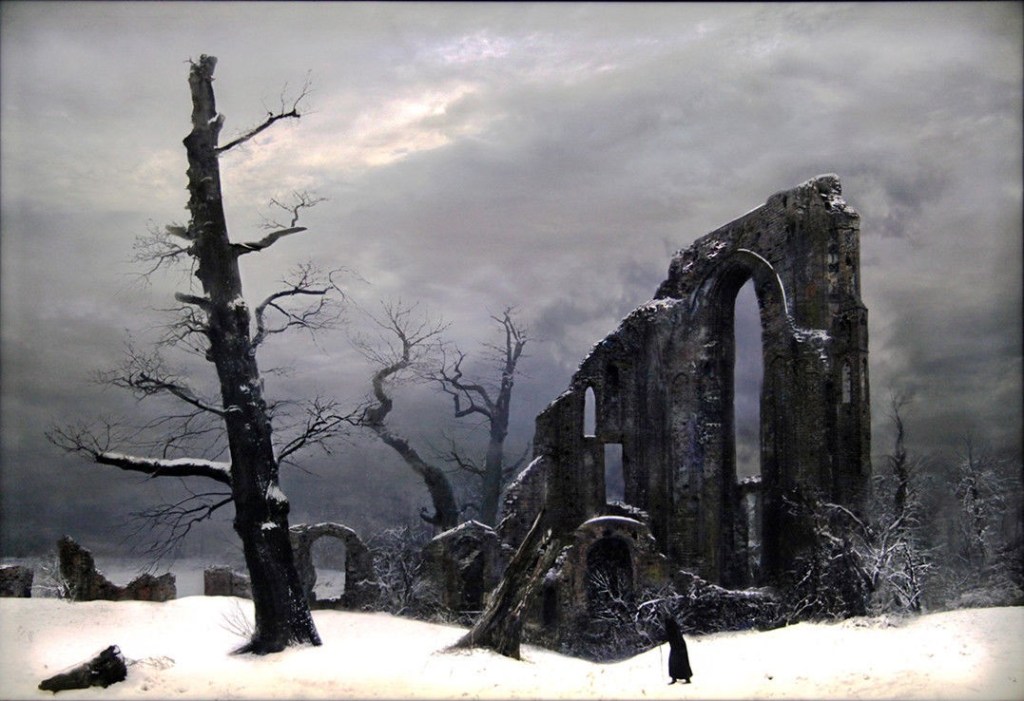
Image: Caspar David Friedrich (1774 – 1840): Monk in the Snow
 Planet Literature
Hinterlasse einen Kommentar