How a Poetic Painter sees a Winter Landscape
Jules Breton (1827 – 1906) was a painter by profession, but also wrote poetry. However, as his poem Beau soir d’hiver (Beautiful Winter Evening) shows, his poems were often influenced by his work as a painter.
Beautiful Winter Evening
The snow spreads its virgin sheet
as a desert-white ocean over the land.
But rising from its swirls,
floating in green gold and delicate blue,
the full moon twinkles on the deserted horizon.
Sleepily the sun god breathes
a last majestic smile into the world,
a crimson robe of vapour,
that wraps itself with wooly arms
around the blushing moon goddess.
The lily pallor of the sparkling snow
glows in the shimmering dream of light.
Its flowery white drapery embroiders
the land with the glittering dust of stars
over the pink blossoming vastness.
Jules Breton: Beau soir d’hiver from: Les champs et la mer (1883)
On Breton’s Artistic Career
The French painter Jules Breton (1827 – 1906) was already highly renowned during his lifetime. He received numerous awards, and his paintings sold at top prices by the standards of the time.
His works were also extremely popular in the USA. In a contest held by the Chicago Daily News in 1934, his 1884 work The Song of the Lark was voted the „most beloved work of art in America“.
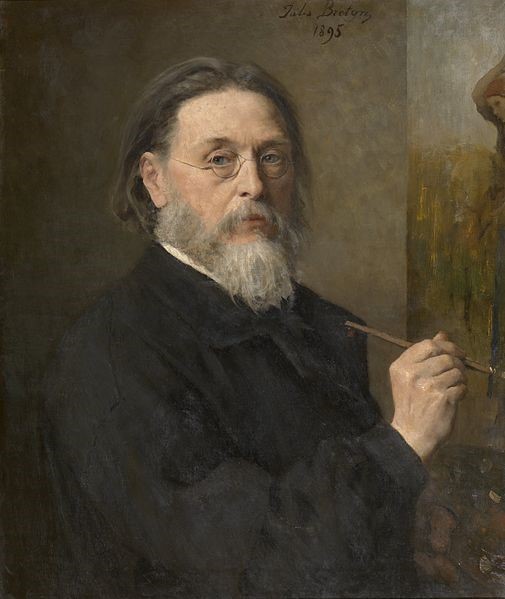
The fact that Breton was able to pursue an artistic career was largely due to the Belgian painter Félix de Vigne (1806 – 1862), whose daughter Elodie Breton was later to marry. De Vigne recognised Breton’s talent early on and persuaded his parents to let their son study at the Academy of Fine Arts in Ghent.
In keeping with his discoverer’s focus, Breton initially turned to historical subjects. However, he soon realised that his real preference was for nature painting and the depiction of rural life. So in 1852 he moved from Paris, where he had continued his studies at the École des Beaux Arts, back to his home village Courrières in the Pas-de-Calais region of Northern France. From then on, he devoted himself to the artistic design of the landscape and people of his home region.
The Poetic Eye of the Painter
Breton’s close connection with nature and everyday rural life is also expressed in his poetic work. It is interesting that the artist, even as a poet, seems to look at the world through the eyes of a painter.
Thus, many of his verses convey a distinctly vivid impression of the scenery depicted. The reason for this is that Breton, as a painter, has a special eye for details. He observes very closely how the colours of particular plants combine with certain lighting conditions to create a special tableau. The atmosphere that emanates from this is what he tries to capture in his paintings as well as in his poems.
Looking Behind the Outer Shell of Things
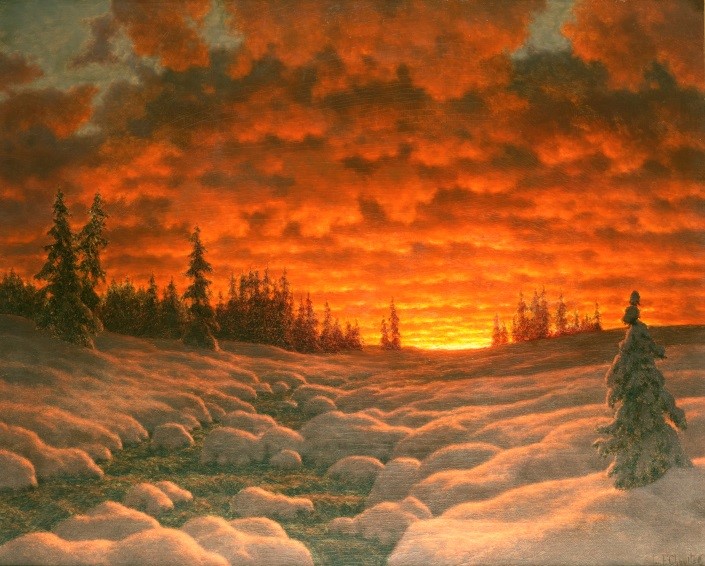
In Breton’s winter poem, too, colours play a central role – in this case, the special reflections and colour combinations created by a sunset over a snowy winter landscape.
Of course, this again reveals the painter’s particular view of the world. But beyond that, Breton’s vivid description of the play of colour also helps us to get a general idea of the artistic. He shows us the difference between a realistic depiction of reality and a depiction that results from an artistic look at the world.
In Breton’s poem, the colours seem to be detached from things, as it were. They appear like elements on the painter’s colour palette, which he uses to redesign what he sees.
In fact, this is a decisive characteristic of artistic expression: The artist detaches the elements of reality from their predefined structures and reassembles them in the imaginative space of art. In this way, something new is created. Something that admittedly takes up the structures commonly recognised as reality, but adds to them the subjective reality of the artistic gaze.
Thus, in Breton’s poem – and in the corresponding paintings – we do not simply get an image of winter, but the draft of a winter mood that goes far beyond the mere image of reality.
Images: Iwan Fjodorowitsch Schultze (Ivan Fedorovich Choultsé, 1874 – 1939): Winter sunset; 1920; wikimedia commons; Jules Breton: Self-portrait (1896); Antwerpen/Belgium, Royal Museum of Fine Arts (Wikimedia Commons)


 Planet Literature
Hinterlasse einen Kommentar