
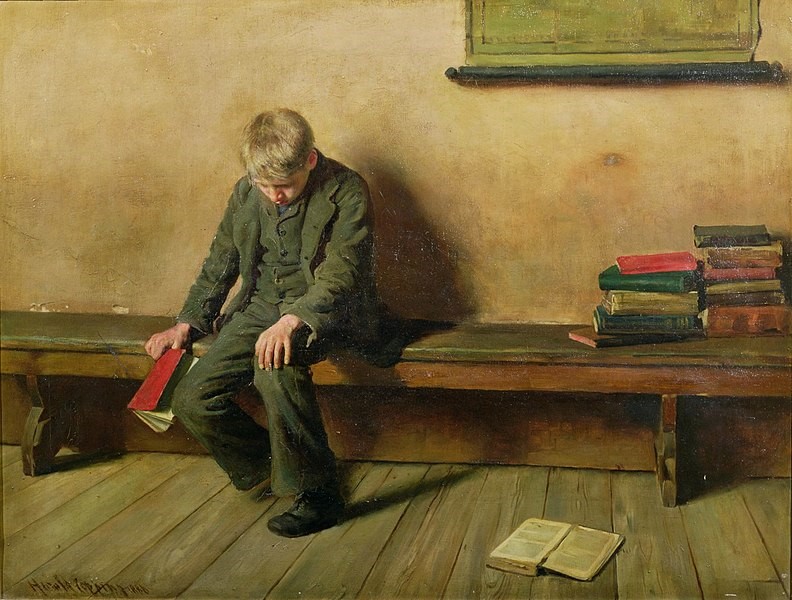
Start of a Five-Part Series with Poems by Jacques Prévert
For the French poet Jacques Prévert, school was – also from his own experience – more of an obstacle than a catalyst for the free spirit. His poems therefore repeatedly call for turning away from the traditional understanding of education.
The Dunce
Below him
the parted heads
of the model students,
in front of him
the lurking gaze
of the teacher.
The fusillades of questions
rain down on him,
he staggers
in the hail of bullets of problems
that are not his own.
But suddenly
the bright madness laughs
through his gloomy face.
He reaches for the sponge
and simply wipes it away,
the labyrinth of facts and figures,
of data and terms,
of phrases and formulas,
and under the cheering of the class arena
he paints over in rainbow colours
the dark board of unhappiness
with the radiant face of happiness.
Jacques Prévert: Le cancr from: Paroles (1946)
Prévert’s Difficult Childhood
Looking at the biography of the French poet Jacques Prévert (1900 – 1977), some might be inclined to say that this author did not exactly imbibe poetry with his mother’s milk.

Prévert’s father had to eke out a living with odd jobs for a long time before he finally found work with a charity association in Paris [1]. In the jungle of the big city, the son fell into the petty crime milieu, so that Prévert himself later wondered about the „virginity“ of his criminal record [2]. In all this, school was nothing more than an annoying evil, and skipping lessons consequently led to leaving school as early as possible (at the age of 15).
Critical View of Traditional School Education
If someone had asked Prévert how he could become a poet with this limited formal education, the answer would probably have been that this had happened not despite, but rather because of his distance from the school system. Thus, for example, he argued against the standardisation of intellectual progress that lockstep learning in school entails.
According to Prévert, to say that a child does not progress in school often overlooks the other developments that a child undergoes, which are not measured by school tests and may not even be related to instruction [3]. With the French philosopher Montaigne, Prévert therefore criticizes the „imprisonment“ of the child’s mind in school, where it is at the mercy of the whims of a bad-tempered teacher and thus deprived of its individual potential [4].
With the Bird of Imagination against Intellectual Paternalism
In Le cancre – the poem reproduced above –, a pupil rebels against the mental oppression by wiping away all the abstract facts and figures he is supposed to learn from the blackboard and painting them over with the „face of happiness“.
Analogously, in Page d’écriture (Task Sheet), the conditions for mental freedom are created precisely by the fact that the pupils turn away from the teacher’s repetition exercises and devoting themselves to the bird of imagination, whose song causes the walls of the classroom – and thus the school reality – to collapse:
Arithmetic Exercise
Two plus two makes four
plus four makes eight
which makes the same
when multiplied by two
minus four makes four again
a tightly woven arithmetic chain
round the numbers round the heads
on accurately demarcated squares
suddenly
out of the blue
a trembling feather
a bird’s feather in front of the window
gliding past the classroom
gliding into the hearts
an unpredictable song
breaking the tightly woven chain
round the numbers round the heads
into countless spiritual sparks
a sea of colourful marbles
incalculably glittering
freed
the pencil dives into it.
And the numbers turn into objects again
the glass panes turn into sand
the ink turns into water
the desks turn back into trees
the chalk becomes a chalk rock
and the pencil a bird [5].
The „Unchained“ Child as a Public Nuisance
Another poem by Prévert about childhood and traditional education is Chasse à l’enfant (Child Hunt / Hunt for the Child). It is based on a true incident – the uprising against the violence of the guards and the subsequent escape of inmates from a Breton reformatory for minors in 1934. For those who helped to apprehend one of the fugitives, a reward of 20 francs was offered.
Prévert takes up the incident in his poem from the perspective of a child on the run. Like a „hounded animal“, it is chased by the „pack of decent people“, who perceive its escape to freedom as an attack on the social order and seek to punish it accordingly. The fact that the reference is not to just any child, but to „the“ child in general elevates the unbound, untamed child to a symbol of the intellectual freedom suppressed in everyday life in bourgeois society.
The poem thus describes the child’s attempt to escape as an example of the self-assertion of the human spirit, beginning with its resistance against its suppressive moulding at school. In other words, intellectual freedom is only possible in the long term if the spirit’s wings are helped to unfold instead of being clipped at school.
Child Hunt
On their wings, the seagulls
playfully catch the sparkling light
that dabs the waves
around the island with stars.
All of a sudden, shouts resound like gunshots:
„Rascal! Hooligan! Deadbeat! Scoundrel!“
It’s the pack of decent people,
dutifully chasing the unbound child.
Like a wounded animal
the child strays through the gloomy night,
while behind him the cries
of the decent people resound:
„Rascal! Hooligan! Deadbeat! Scoundrel!“
Nobody needs a hunting licence
for hunting the child. The freedom of hunters
stands above the freedom of the child,
who flees through the gloomy night.
„Rascal! Hooligan! Deadbeat! Scoundrel!“
The arms of the moon reach ghostly
between the night-pale waves
into which you plunge your unbound arms.
Will you reach the shore? [6]
References
[1] On the occasion of the 40th anniversary of Prévert’s death in 2017, several monographs on the author and his work were published, including biographically oriented appreciations of his work (cf., among others, Aurouet, Carole: Jacques Prévert. Une vie. Paris 2017: Les Nouvelles Éditions JMP; Hamon, Hervé: Prévert, l’irréductible. Tentative d’un portrait. Paris 2017: Lienart). Another detailed study on Prévert dates from 2021 (Perrigault, Laurence: Prévert. Paris 2021: Les Pérégrines, Collection Icones).
[2] Cf. Prévert’s statement in an interview with André Pozner: Prévert/Pozner: Hebdromadaires (1972), S. 85. Paris 1982: Gallimard.
[3] „Un enfant, (…) à l’école, on dit: il ne fait pas de progrès. Pourtant, on ne sait pas, on ne peut pas savoir s’il n’en fait pas, dans une direction différente“ – „Often a child at school is accused of not making progress. But the truth is that we cannot know that at all. Perhaps the child is making progress, only in a completely different direction“ (ibid., p. 101).
[4] Ibid., p. 101 f.
[5] Cf.Prévert: Page d’écriture; from: Paroles (1946), p. 146 f.
[6] Cf.Prévert: Chasse à l’enfant (PDF); from: Paroles (1946), p. 86 f. Song version by Les Fréres Jacques (1957).
Harold Copping (1863 – 1932): The Dunce (1886); Bournemouth, Russell-Cotes Art Gallery & Museum (Wikimedia Commons); Photo of Jacques Prévert (1920s); photographer unknown; Paris, Musée Carnavalet

 Planet Literature
Hinterlasse einen Kommentar