
Excerpt from Nadja Dietrich’s Novel Emperor’s Eyrie
After escaping from the psychiatric ward, Carlo, the protagonist of Nadja Dietrich’s novel Emperor’s Eyrie, retreats to a remote mountain hut. There he also regains the strength to devote himself to his work as a painter.
The relativising effect of the mountains has always been an effective remedy for me. The mountains just have their own reality, against which all other realities pale into insignificance.
This has helped me out of many a dark valley in the past when I felt trapped in my artificial world of art – when I stood in my studio among all the paintings, these mirror shards of my own self, in which my view of the world was refracted and whose cacophony of voices flowed back into myself. Sometimes my paintings seemed to me like grown-up children who refuse to leave home, thus preventing not only themselves but also their parents from reconnecting with the world.
Perhaps works of art are indeed a bit like children. They have to set out into the world, go their own way, find their own place, their own meaning in lively contact with others. Every work of art is designed with a You in mind; it needs a bridge to a living counterpart in order to unfold. Without this element of dialogue, it basically doesn’t exist.
Of course, a work of art also carries its meaning within itself in a way. From the artist’s subjective point of view, it is a special way of coming into contact with the world, an appropriation of the world that simultaneously aims to transform and recreate it.
However, this self-sufficient meaningfulness only applies to the artistic process itself. Once this process has come to an end, meaningfulness for the artwork can only be gained through a renewed creative process, as represented by the lively dialogue of others with it. Since the creation of art is inextricably linked to the subject’s externalisation in his works, the refusal of this dialogue also implies the latter’s spiritual death to a certain extent.
Objective events and subjective perception, though, are not congruent in this case either. Spiritual death is only perceived as such and has a corresponding effect on artistic activity if the artists‘ self-image is based on the social reality from which their spiritual death arises. If they settle in a different reality, they are immune to what happens to their works in social reality.
For me, it is precisely this immunisation that life in the mountains brings about. It has something of a life in a monastery, where those praying – regardless of their contact with the social reality outside the monastery – live in a world of their own, whose laws are fundamentally different from the world beyond the monastery walls. Most importantly, every communicative act there – no matter to whom it is directed – is rooted in the great transcendental You from which the meditators draw their strength.
This does not mean that I would pray and meditate all day long in my mountain hut – nor are the paintings I create here primarily of a religious nature. It is simply that up here I no longer feel directly affected by social reality, although my paintings still emanate from it and are aimed at it.
I feel much more free here to express exactly what is struggling for expression within me and to shape it accordingly. I no longer worry about the possible preferences of those who might one day bring the finished work of art to life with their creative processes of perception and interpretation.

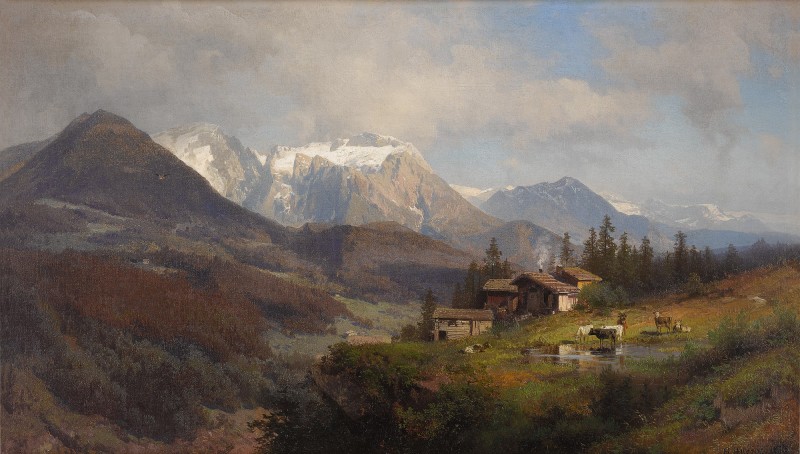
Image: Hermann Ottomar Herzog (1832 – 1932): Alpine Village (1873); Wikimedia Commons)
 Planet Literature
Hinterlasse einen Kommentar