
Jacques Prévert and Surrealism
Jacques Prévert frequented surrealist circles for a long time and was therefore influenced by them in his poetry as well. This is particularly evident in the collage-like elements in his poems.
The Ticket Inspector
Come on now!
Hurry up!
Move, move!
Move closer together!
There are far too many travellers here,
far too many!
So come on:
Move together! Hurry up!
Some are already queuing,
travellers everywhere,
far too many, all over the place,
at the landing stage,
in the corridors
in the belly of their mother,
so move, move: move together,
pull the trigger!
Everyone needs space to live,
so kill yourselves a little!
Come on, come on, be sensible,
give way,
you can’t stay long here anyway
everyone needs space to live,
just a little round,
you were warned,
just a little tour around the world,
nothing but a tiny trip,
then you have to get out,
so move, move,
move closer together,
be polite to each other,
don’t push,
everyone will have their turn!
Jacques Prévert: Le contrôleur from: Paroles (1946)
The Laughter of the Surrealists
Jacques Prévert repeatedly emphasised his aversion to the sacred seriousness of high-culture poetry. This also applied to the alienating effects he achieved with his unconventional metaphors. With them, he also explicitly wanted to evoke „laughter“ and thus provide „consolation“ for all those people who are „slaves“ to absolute truths [1].
This approach points to Prévert’s connection with the surrealist movement, which had a decisive influence on his work. Thus the poet characterised the surrealists on several occasions through the manner of their laughter. According to Prévert, it was „irresistibly infectious“ and „salutary“ in its orientation against all the hypocrisies and the insidiousness of bourgeois society.
Another point Prévert emphasises is that the surrealists also laughed at each other so as not to take themselves too seriously. They would even laugh at death in order to be able to deal with life more fearlessly [2].
The aim of all this was to preserve unconditional spiritual freedom. According to Prévert, freedom was not just a buzzword for the Surrealists. Rather, they tried to realise it in their art – even if this was of course only possible in an approximate way [3].
The fact that Prévert gradually distanced himself from the surrealists from 1930 onwards was not least due to the fact that he wanted to live out his intellectual freedom to an even greater extent than he could under the increasingly dictatorial regime of their leader, André Breton. Prévert later explained his disagreement with the latter by referring to Breton’s „somewhat strange understanding of the freedom of others“ [4]. Nevertheless, in retrospect, he also acknowledged Breton’s ability to laugh at the ridiculous seriousness of bourgeois society as well as at himself:
„Breton is often referred to with great seriousness. But the truth is that he laughed [a lot], that tears even came to his eyes from laughing. He was never serious. His words were sometimes fraught with meaning, perhaps even a little too often for my taste, but overall it was like this: we laughed together, like people who really like each other“ [5].
Prévert as Scriptwriter and Creator of Collages
Another important characteristic of surrealism mentioned by Prévert is the fact that this artistic movement was not limited to a specific type of art. This also applies to Prévert’s own artistic work. Thus, according to his own statements, it was only through film that he found his way to literature [6] – and he continued to be involved in the film world later on.
Of particular importance is the animated film Le roi et l’oiseau (The King and the Bird), a poetic satire on despotism and militarism, which Prévert created together with Paul Grimault [7]. The film, based on Hans Christian Andersen’s fairy tale The Shepherdess and the Chimney Sweep, was not released in cinemas until 1979, two years after Prévert’s death, after a first version completed in 1948 had been rejected by Prévert and Grimault. The final version of the screenplay was revised by Prévert until shortly before his death.
Another of Prévert’s artistic focal points is also closely linked to surrealism. After a serious fall from an inadequately secured French window, after which Prévert only recovered very slowly, he increasingly produced collages from the end of the 1940s [8] – an art form that also played a central role in surrealism.
Collage-like Elements in the Poem Le contrôleur
A key feature of the collage is simultaneity – a way of placing seemingly unrelated things or events next to each other and thus create unexpected references. This stylistic device can also be found in Prévert’s poetry. The grotesque effects brought about by collage-like elements can be observed, for example, in the poem Le contrôleur (The Ticket Inspector) reproduced above.
The poem combines two areas of meaning. On the one hand, there is the tidal rhythm of life, the coming and going of human individuals who are born and disappear from the world in the blink of an eye. On the other hand, we have the imagery of an overcrowded train or ship on which people are travelling through life in a tightly packed space.
The connecting element between the two complexes of meaning is a ticket inspector who repeatedly reminds the travellers of the ephemeral nature of their journey through life. Again and again, he asks them to move closer together and give way to others who are already approaching their entry into life in the waiting room of their mother’s bellies.
In his disregard for the dignity of individual life, the inspector has decidedly cynical traits. He could therefore generally be seen as the personification of Death, who takes all people away with him indiscriminately. However, by urging travellers to kill each other to make room for new arrivals, his cynical exclamations can also be related to problems such as density stress, overpopulation and lack of resources, which can lead people to act on impulse and, in extreme cases, even trigger wars.
References
[1] Cf. Prévert, Jacques / Pozner, André: Hebdromadaires (1972), p. 153. Paris 1982: Gallimard.
[2] Cf. ibid., p. 165 f.
[3] Cf. ibid., p. 166.
[4] Ibid., p. 21.
[5] „On parle beaucoup de Breton avec un immense sérieux. Quand je dis qu’il riait, qu’il riait aux larmes même, c’est vrai. Il n’était jamais sérieux. Il était parfois grave, peut-être trop à mon avis, mais c’était comme ça. On riait, ensemble, comme des gens qui s’aiment“ (ibid., p. 166).
[6] Cf. Ibid., p. 159.
[7] A detailed study of the film has been published by Jean-Pierre Pagliano:Le Roi et l’Oiseau: Voyage au coeur du chef d’oeuvre de Prévert et Grimault. Paris 2012: Belin.
[8] Cf. Prévert: Collages. Paris 1982: Gallimard [with texts by André Pozner and a foreword by Philippe Soupault].
German Version
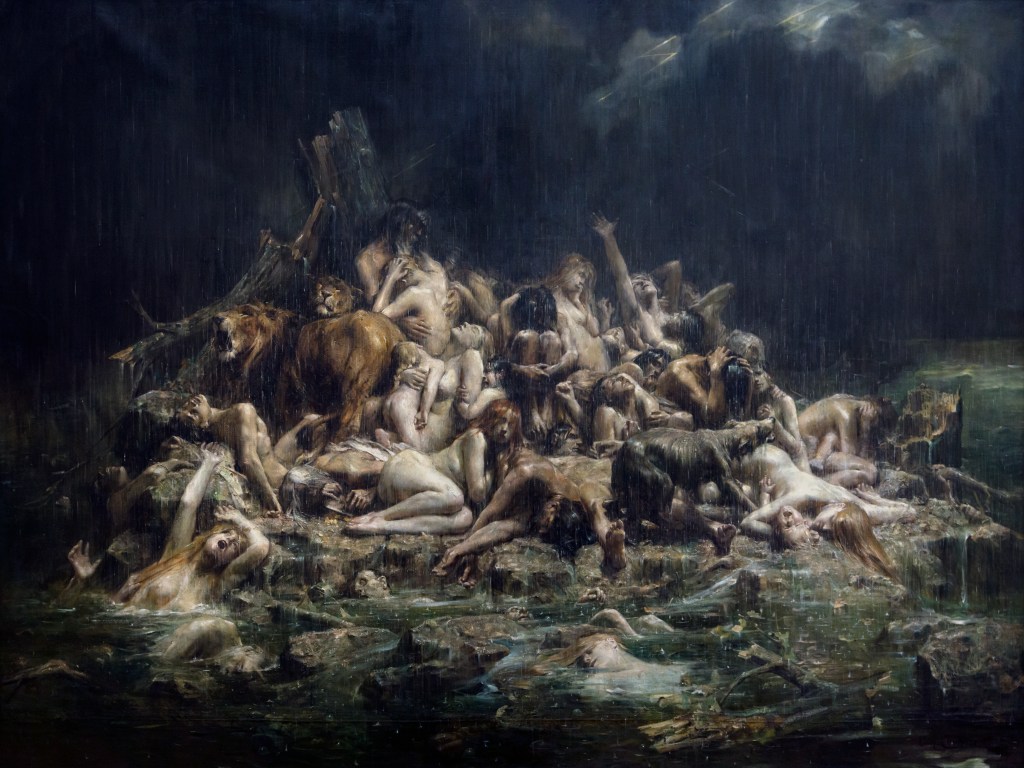
Image: Léon Comerre (1850 – 1916): The Deluge (c. 1911); Museum of Fine Arts Nantes, France (Wikimedia commons)

 Planet Literature
Hinterlasse einen Kommentar