
Excerpt from Nadja Dietrich’s Novel Emperor’s Eyrie
Part 2 of Nadja Dietrich’s novel Kaiserhorst is set in the mountains. These are therefore also a recurring starting point for philosophical reflections.
An evening in the village pub: the male choral society gives a demonstration of its skills. Vibrating voices, great pathos. What remains is the impression of a tremendous dissonance. The songs celebrate the beauty of the homeland, the lyrics are full of reverence for the rugged rocks and the unattainable peaks – but at the same time the singers appear anything but humble. They seem overwhelmed by the grandiosity of their own emotional world rather than by the beauty of the mountains.
Perhaps this is the result of a habituation effect. When people live permanently in the mountains, this may weaken their sense of the power to which the mountain world owes its existence and which transcends human imagination. Instead, the feeling spreads that, as people living in this world, they themselves are part of this power. The result is a kind of megalomania, through which the self puts itself in the place of the true demiurge: Mother Nature. Those who act out of this megalomania, though, end up destroying the very magnificence that feeds their fantasies of omnipotence: the harmony of an unspoilt natural environment.
The only person with whom I can talk about such topics here is Tony. This is not least because he is completely different from the other men in the village. While the bodies of these blokes look a little like the giant trees they regularly slay in the forest, Tony has distinctly delicate facial features, narrow shoulders and a groping, almost floating gait. Thus his outward appearance alone signals resistance to the ideal of masculinity that prevails here.
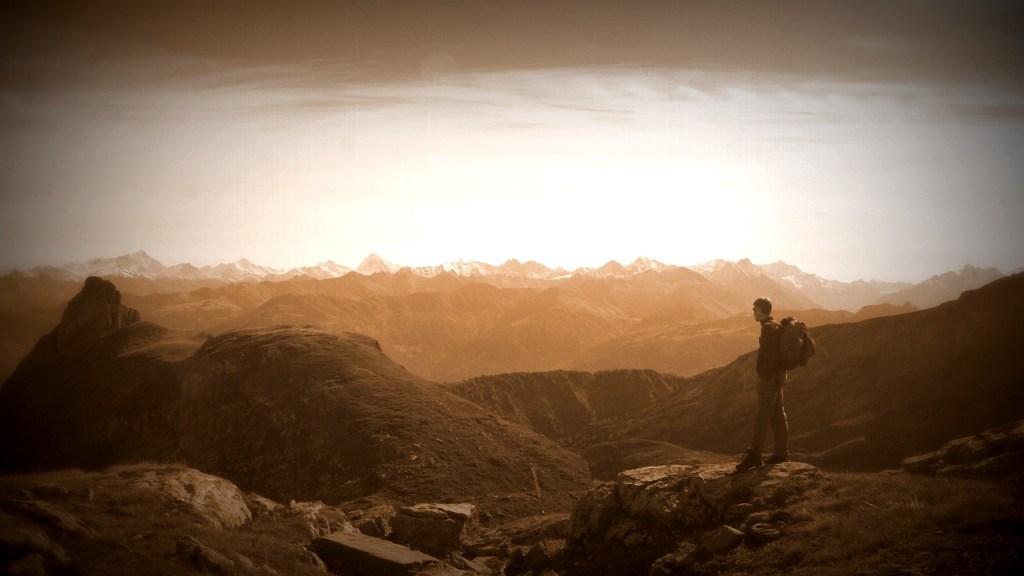
I still remember how we once climbed a mountain together. It was one of those sunny late autumn days when the softer, maternal light envelops the melancholy of parting with the comforting certainty of endurance. Everything will return, it whispered to me, everything will appear again at some point in exactly the same manner as at this moment, regardless of you, who are only the momentary mirror of this mood.
Tony, who is a passionate and experienced climber, had chosen what he called a „granny tour“ for my sake and avoided via ferratas as well as steep paths. However, there were still over a thousand metres of altitude to conquer. Accordingly exhausted, I dropped down next to the summit cross when we finally reached the top. Tony, by contrast, sat down on a rocky outcrop with his arms bent backwards as if after a relaxing Sunday stroll.
For a while, nothing could be heard except my gradually diminishing panting and the hoarse „Krah-krah“ of two ravens hovering above us. Then Tony said into the silence without turning round to face me: „Yeah, that’s it“: everything is one …“
I was already familiar with his spontaneous philosophy and therefore responded in a similarly casual tone: „Spiritual highs in a high-altitude frenzy, eh?“
Tony laughed. „Sure – it’s better than any drug trip! But seriously, don’t you think the opposites disappear up here? You only have to look down: The boundaries are blurred, everything flows into each other, everything is connected …“
„Oh, what a meaningful murmur,“ I teased him. „As the poet says: There is peace above the peaks …“
I was tired and wanted to get some rest. But Tony wouldn’t let up. „I think,“ he continued, „that learning from the mountains means overcoming the opposites, reconciling them with themselves, bringing them together in your own person.“
His persistent philosophising provoked me to contradict him. „But can’t opposites also be fruitful sometimes?“ I objected. „After all, there is surely a kernel of truth in the saying that opposite attract.“
Tony turned halfway round to face me. The ponytail he had tied his shoulder-length hair into shone like a tail of fire in the backlight. „Sure, that’s what they say,“ he confirmed. „But the correct saying should be: differences attract. Without differences, there would be no development, then everything would still rest undivided in the cosmic primordial core. Similarly, for a human being to be born means to become distinguishable. The ideal of indistinguishability, of uniformity, is the ideal of the totalitarian, not of totality. However, this does not mean that we need opposites in order to find each other attractive. Opposites that are too strong always lead to conflict and war in the long term.“
I stifled a yawn. „So now we two are overcoming opposites by conquering the peaks?“
Tony leant back and gave me a friendly punch in the side. „Ouch!“ I complained and punched back.
Tony laughed. „You just always have to be on your guard,“ he then added, although it was unclear whether he was referring to his attack on me or his philosophical reasoning. „A life full of opposites and contradictions can very quickly tear you apart inside. That’s why I strive not to let the different aspects of my self become opposites in the first place, but to connect them somehow. The result is what I call ‚inner balance‘.“

Image: Steffen Thomas: Mountaineer in Valais/Switzerland (Pixabay)
 Planet Literature
Hinterlasse einen Kommentar