
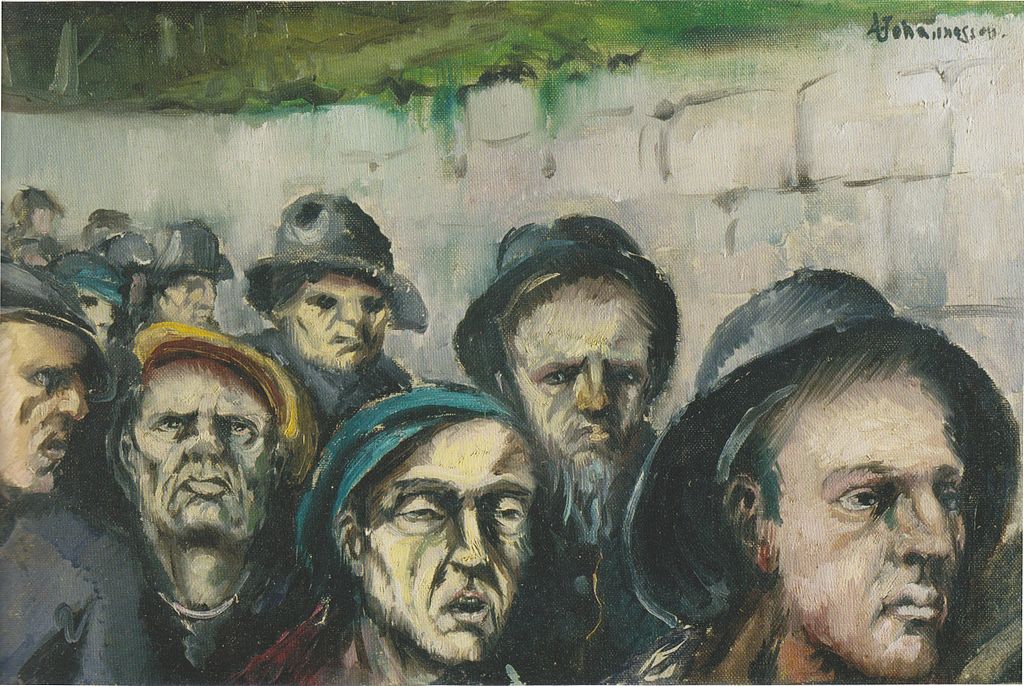
Criticism of Capitalism and the Official Church in Jacques Prévert’s Poems
Jacques Prévert’s criticism of capitalism and the official Church were closely linked. Both were accused by him of criminalising the spontaneous enjoyment of life.
Wasted Time
In front of the factory gate
a faltering step
a questioning look back:
the smile of the sun
in the leaden sky
at the steel-cold gate
in the empty eyes
that, blinking, become filled with life
at one with the sun
united with the golden goddess
in the celebration of life
that would be wasted
in a factory.
Jacques Prévert: Le temps perdu from: Paroles (1946)
Criticism of Capitalism and the Church in Prévert’s Poetry
Prévert’s criticism of capitalism and the official Church are closely linked. For him, his insistence on the spontaneous joy of life is just as much an act of lived resistance against an anti-pleasure church ideology as it is a protest against the subordination of the individual to the interests of an economy that is hostile to life.
According to Prévert, the coercive system of the Church forces faith on children [1] and regards atheism in adult non-believers as a temporary apostasy, a kind of illness that will eventually be overcome [2]. It thus appears as a breeding ground for suppression, facilitating the imposition of inhumane social norms on people.
In this sense, the worker who, in the poem Le temps perdu (Wasted Time), decides to enjoy the sunny day rather than waste it in a factory, sins both against the laws of the capitalist economy and against the norms of the official Church: Under the conditions of capitalist value-added thinking, the ecclesiastical commandment „you shall rest on the seventh day“ is transformed into a dictatorial „you may only rest on the seventh day“.
The rhythm of life prescribed by the official Church thus supports an inhumane system of employment, in which Sunday rest only serves to spare the labour force to such an extent that it can be exploited with maximum profit during the week. The hours of leisure are intended to serve physical regeneration, but not to allow people to reflect on their lives and call the existing structures into question.
Prévert as a Critic of the Capitalist Economy
In the 1930s, Jacques Prévert collaborated intensively with the Groupe Octobre [3] – a theatre group with close ties to communism, which supported striking workers with performances on location. Among the texts that Prévert wrote for the Groupe Octobre between 1932 and 1936, the year the group disbanded, was also La bataille de Fontenoy (The Battle of Fontenoy). It was performed in 1933 at the International Workers‘ Theatre Olympics in Moscow and thus became internationally known.
Prévert’s collaboration with the Groupe Octobre and his contact with workers fighting for their rights made him particularly aware of injustices in the world of labour. This was still clearly noticeable in later years. Thus, he deplored the amorality of an economy that created working conditions which – as in the case of silicosis, the most common occupational disease among miners – were associated with fatal illnesses for the employees [4].
Prévert was equally critical of the euphemistic renaming of jobs. By giving them a „hip“ image, the new designations would conceal the lack of attractiveness of the work, instead of compensating for it with appropriate pay [5].
Life-threatening Obsession with Duty
In this context, Prévert refers to the New York street sweepers („balayeurs“ in French), who, as he recalls in an interview, had turned the skyscrapers into „rubbish scrapers“ with a strike. This also links his critiscism to his prose poem Le balayeur (from the collection Spectacle, 1951).
In Prévert’s text, the street sweeper goes on a kind of wildcat strike with his spontaneously lived-out, undutiful enjoyment of life. In doing so, he does not oppose a worldly but rather an ecclesiastical authority, which appears to him in the form of a stern angel. However, it is a central aspect of Prévert’s criticism of the Church that it misuses religion to lend transcendental legitimisation to inner-worldly duties [6].
Prévert defends the „anti-clericalism“ of which he was accused by his critics by pointing out that the clergy are themselves representatives of „anti-tout“: „They are against everything that is pleasant in the world“ [7]. In his prose poem Le balayeur (The Street Sweeper) – here transposed into a narrative text for the sake of clarity – he illustrates this in a tongue-in-cheek manner:
The Street Sweeper
Once God’s strict angelic guardian caught the street sweeper lazing around. „Oh dear God!“ the latter had said to himself. „All that dust! The wind will play with it again anyway. Why don’t I just let it do my job and blow the dust into the river?“
So he sat down on a stone, daydreaming, and watched the lovers strolling past.
But it wasn’t long before the soft, warm air began to tremble, an ominous sound disrupted the harmony of the summer day, and the angel appeared in front of the street sweeper. Stretching his index finger to the sky, he made the forgetful man’s face flush with shame. Instantly, the repentant sinner grabbed the broom again and got back to work.
Shortly afterwards, however, a beautiful woman appeared on the scene. Leaning against a bridge railing, she looked down at the river. The street sweeper couldn’t help himself: he dropped his broom and leaned next to the outstanding beauty. Without her noticing him, he gazed at her adoringly.
The angel, though, was not unaware of the renewed misbehaviour. He moved to the other side of the street sweeper and fixed him with the simultaneously caring and reproachful gaze of a rigorous teacher. So the street sweeper guiltily resumed his work.
A few minutes later, a second beauty turned up who, as the street sweeper found, again deserved his admiration and attention far more than his broom. But as soon as he began to gaze at her, the angel appeared again. This time he did not show up to his protégé, but stood up in front of the adored one. Startled, she fled.
Once again, the angel reminded the street sweeper of his duties. As a result, his unwanted pupil swore to himself that from now on he would not let anything or anyone get in his way. As if in a trance, he let his broom dance through the dust.
Suddenly, screams could be heard coming from the river. A young woman had fallen into the water and was in danger of drowning. But the street sweeper paid no attention to the screams. „Why should I care?“ he thought to himself. „I’m here to sweep the street, everything else is not my business.“
When the angel appeared in front of him, he waved his broom even more vigorously, even more dutifully, so that the emissary of God was enveloped in a thick cloud of dust. From this cloud, the angel once again appealed to his protégé’s conscience. He told him that it was commendable to fulfil his everyday duties, but that there were higher duties for which he had to interrupt his work at any time – and that of course included saving the lives of people in need.
The street sweeper initially turned a deaf ear. After all, it could not be ruled out that the devil, disguised as an angel, was once again trying to lead him astray. In the end, however, his saviour’s instincts won out. With a courageous leap, he dived into the water to help the drowning woman. And because he was a good swimmer, it wasn’t long before he had brought the woman to shore.
The angel praised the grace of God, he praised the Lord, prayers of gratitude poured from his lips – until he saw how beautiful the rescued soul was, how seductive … and how naked. Disapprovingly, he shook his head as the street sweeper laid the woman’s motionless body on a bench, touched her like a fragile flower to see if she was still alive, and then breathed new life into her with his own breath.
Soon this masterpiece of nature came back to life. The woman opened her eyes and turned them lovingly towards her saviour, she smiled at him … And while the angel indignantly asked the street sweeper to throw this Satanic creature back into the river, the two of them just laughed and floated off into heaven without any divine assistance.
Alone in the dust of the street, the angel grabbed the broom and swung it furiously, as if he could sweep all the devils and demons out of the world with it. [8]
References
[1] Prévert, Jacques / Pozner, André: Hebdromadaires (1972), p. 58. Paris 1982: Gallimard.
[2] Ibid., p. 63.
[3] On Groupe Octobre, cf. Jolly, Haramila: Le groupe Octobre et le communisme. Une mémoire reconstruite. In: Revue Française d’Histoire des Idées Politiques 8 (1998), pp. 339 – 354.
[4] Prévert, Jacques / Pozner, André: Hebdromadaires (see above: 1), p. 162 f.
[5] Ibid., p. 121.
[6] Ibid., p. 41.
[7] Ibid., p. 56.
[8] Cf. Prévert: Le balayeur; from: Spectacle (1951).
Image: Aksel Waldemar Johannessen (1880 – 1922): Workers (c. 1915); Wikimedia Commons

 Planet Literature
Hinterlasse einen Kommentar