
Excerpt from Nadja Dietrich’s Novel Emperor’s Eyrie
His search for clues to the secret of „Emperor’s Eyrie“ leads Carlo, the protagonist of Nadja Dietrich’s novel Emperor’s Eyrie, to an imposing monastery library – a gigantic monument to the spirit.
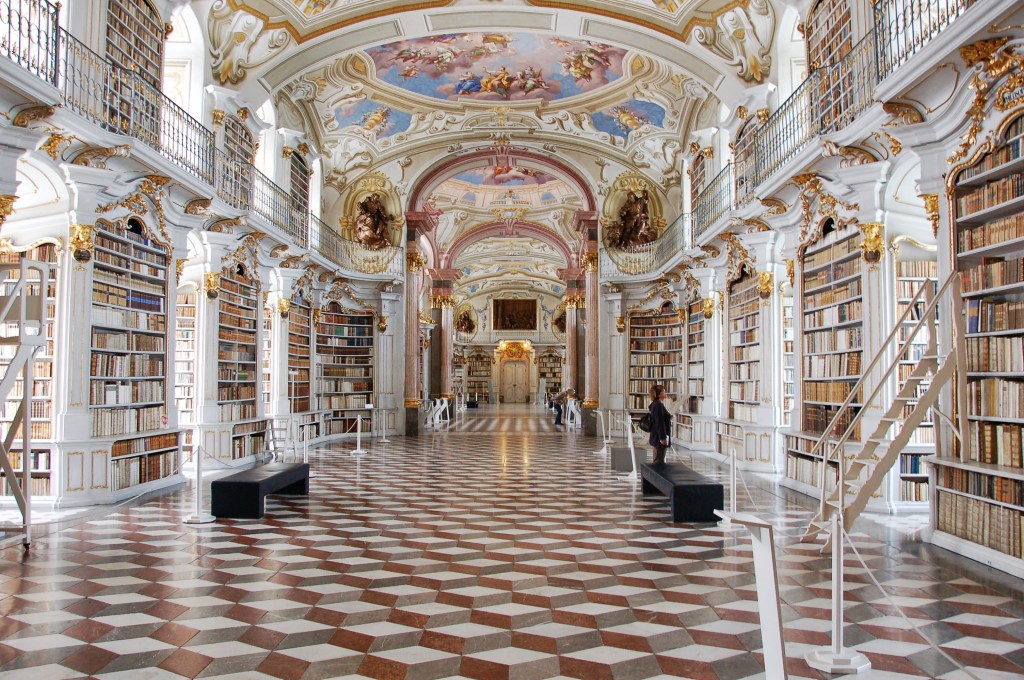
Anyone entering this library is inevitably carried away to higher spheres. The sumptuous hall that welcomes visitors, with its bookshelves framed by antique columns, the gold-framed ceiling frescoes and the gleaming marble floor that absorbs and reflects the sparks of knowledge, is a veritable cathedral of the spirit.
The centuries-long struggle with the unsolvable riddles of humanity and the universe, the approach to a goal that will remain eternally unattainable, but whose contours nevertheless appear in those who set out on the stony path to it, breathes at the visitor from every crack in the wall. Thus the spirit celebrates itself in all this splendid ornamentation, but at the same time bears witness to its reverence for that other Spirit, whose ways it can only ever fathom in fragments, despite all its devout endeavours.
The ceiling of the room, with its effect of depth and the angelic figures lost in the vastness of the sky, picks up on the dynamic of the spirit that can never be fully grasped and never comes to an end. Nevertheless, it expresses the illusion of completion, of a spiritual path that has reached its fulfilment and in whose written documentation at least a reflection of the totality of life can be found.
This is precisely the sublime consolation provided by books. In them, the belief in the philosopher’s stone still resonates, the hope for the one, all-encompassing work, the book of books, in which the spirit expresses itself completely and directly.
Our current practice of absorbing thousands of streams of knowledge at the same time, making our minds a reflection of the eternally searching, eternally incomplete nature of the spirit, may be more honest and closer to the truth. However, the self-contained book can give us hope for the meaningfulness of our spiritual endeavours, a hope without which we might eventually lose the strength for these endeavours.
Or is it perhaps the other way round? Was the religious belief in the one, all-encompassing spiritual creation merely a walking aid that helped us learn to navigate the world of the spirit? Are our current electronic possibilities not an excessive demand on our minds, but the necessary consequence of a development that enables them to productively utilise their own complex but incomplete structures? Are we only now ready to see in this an echo of the cosmos, the dynamics of whose development remain as unfathomable to us as the dynamics of our own intellectual development?
Thus, in the end, it would have been precisely the monastic cultivation of the spirit, the ever new handwritten copying of all the spiritual journeys, this centuries-long meditation on questions that have constantly raised new questions, that paved the way for a new age of the spirit, in which we no longer search for its unity and essence, but instead focus on the diversity of the spiritual universes hidden within it.
Von einer jungen Nonne begleitet, begibt Carlo sich später zu den Archivräumen:
Behind the door we entered a dark corridor in which an iron spiral staircase led down into the depths. The narrow shaft acted like a funnel, amplifying the echo of our footsteps into a dull staccato. We wound our way further and further towards the bottom, in ever new twists and turns which, together with the faint light, triggered a slight feeling of dizziness in me. It was as if we were gradually slipping out of time and just moving on the spot.
On every floor we passed, our eyes fell on endless shelves of dusty books waiting in the half-light of low rooms to be redeemed by a searching hand. It was the complete antithesis of the library’s magnificent reception hall. While the latter glorified the heights of the spirit, the summits of knowledge, the illusion of an overview, here, behind a tightly closed door, the other side of the spirit became visible.
Here, the hardships of spiritual journeys became tangible, the arduous path through the night of spiritual valleys, where the danger of getting lost, of constant disorientation looms at every bend. While the sumptuous hall celebrated the all-illuminating power of the spirit, the dusty shelves testified to the necessity of faith beyond all religious convictions: faith in the grace of spiritual redemption, in the suddenly flashing paths of connection that show the searchers the way out of the labyrinths of the spirit.
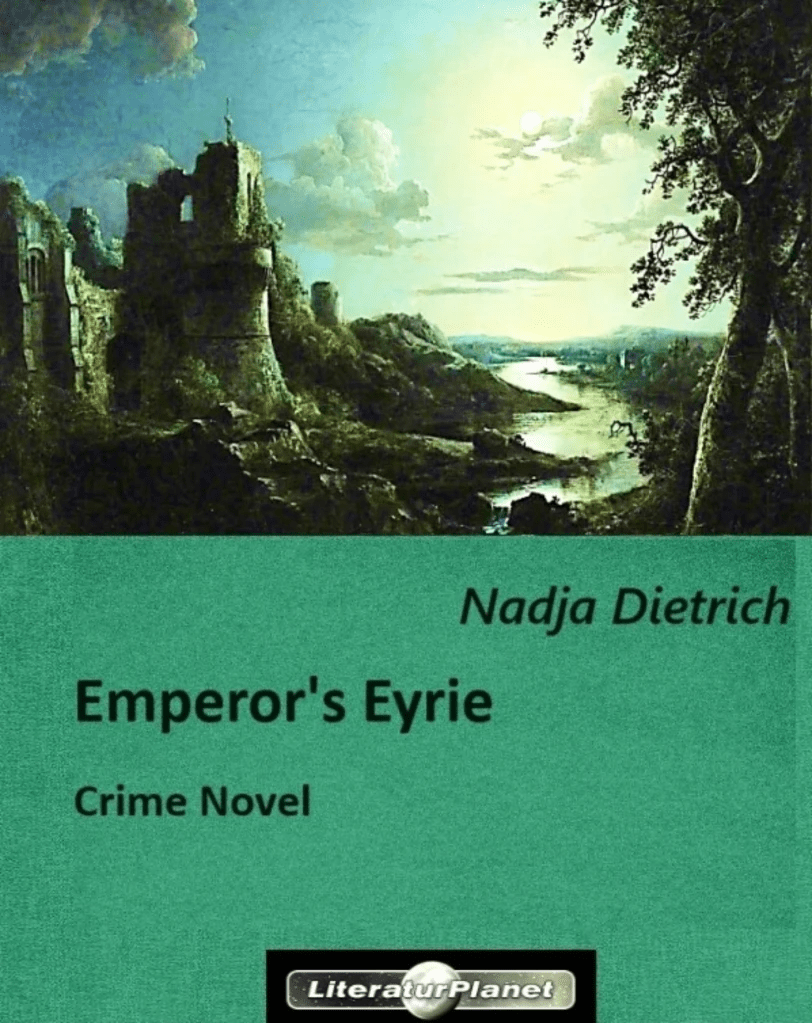
Image: Arcomonte 26: Monastery library in Admont, Styria (Austria); Wikimedia Commons
 Planet Literature
Hinterlasse einen Kommentar