
Poems from Charles Baudelaires Collection of Poetry Les Fleurs du mal/6
For Baudelaire, the path to harmony – in an external and internal, natural and cultural, existential and social sense – leads through the realm of imagination. Its ability to connect seemingly incompatible things and to reconcile opposites is considered a basic element of poetry.
Imagination as a Prerequisite for Creative Thinking and Action
According to Baudelaire, the sense of beauty – understood in the sense of a perfect harmonisation of the parts of a whole, an ideal balance of the relationships existing within it – is created both by external, natural conditions and in the human soul itself. For him, the connecting element between the two is the power of imagination. The French „imagination“ is, however, not the same as fantasy or sensibility – even if both are important prerequisites for the power of imagination. Thus Baudelaires states:
„The power of imagination is an almost divine gift that directly, beyond all philosophical methods, perceives the intimate and secret connections between things, the correspondences and analogies.“
Imagination is thus not primarily a poetic or generally artistic faculty. Rather, it is an indispensable prerequisite for creative thought and action in all intellectual fields. A politician without imagination is only active in an administrative rather than in a creative sense, and a „scholar without imagination appears (…) as an incomplete scholar“ (ibid.), as he is incapable of developing visions that could renew the prevailing paradigms in his field of science.
Synaesthesia as a Central Means of Expression in Poetic Imagination
In the artistic field, imagination serves to fill the natural sense of beauty with life. Baudelaire’s remarks here are reminiscent of the Platonic concept of eternal ideas, the imperishable figures that are concealed behind the external appearances of things. Thus, for Baudelaire, the „immortal sense of beauty“ is what
„allows us to see in the earth and its spectacles a spirit-filled quotation, a correspondence to heaven. The insatiable desire for everything supernatural that reveals itself in the earthly sphere is the most vivid proof of our immortality.“
Inner and outer harmony are thus linked by the fact that man recognises in the language of nature a correspondence to inner-psychic processes and perceives both simultaneously in analogy to cosmic processes. The poetic means by which such a fusion of different spheres can best be expressed is synaesthesia, i.e. the interpenetration of sensory perceptions and their poetic shaping – which is programmatically expressed in the poem Correspondances (Correspondences). It later became an important source of inspiration for Symbolist poetry.
Correspondences
Nature is a temple, where living pillars
sometimes express themselves in bewildering words.
Man wanders through the woods of symbols
that follow him with their familiar glances.
Like echoes blending in the distance
to a whole, founded in the darkest night
and in the brightest clarity, so the scents,
the colours and the sounds are intertwined.
Sometimes the scents are fresh like children’s skin,
soft as oboes, or green as willows,
while others – tainted ones – are rich and triumphant,
with a flavour of infinity,
like ambergris, benzoin, incense and musk,
singing mind and senses into rapture.
Charles Baudelaire: Correspondances from: Les Fleurs du mal (The Flowers of Evil; 1857), p. 91. Paris 1868 (Œuvres complètes / Complete works, vol. 1)
Ambergris: fragrance extracted from the excrement of the sperm whale
Benzoin: resin extracted from trees in East India and Indonesia that smells like vanilla and is used in medicine, as an aromatic substance and in perfume production
Musical setting:
Jean Cras (1879 – 1932): 7 Mélodies pour chant et piano (1909), No. 7; voice: Christophe Crapez; piano: Laurent Wagschal:
Quotations taken from Charles Baudelaire: Notes nouvelles sur Edgar [Allan] Poe (New notes on Edgar Allan Poe; 1857) Preface to Poe, Edgar [Allan]: Nouvelles histoires extraordinaires (New extraordinary stories) [19 pages in four sections]; here: section 3 and 4. Paris 1884: Quantin.
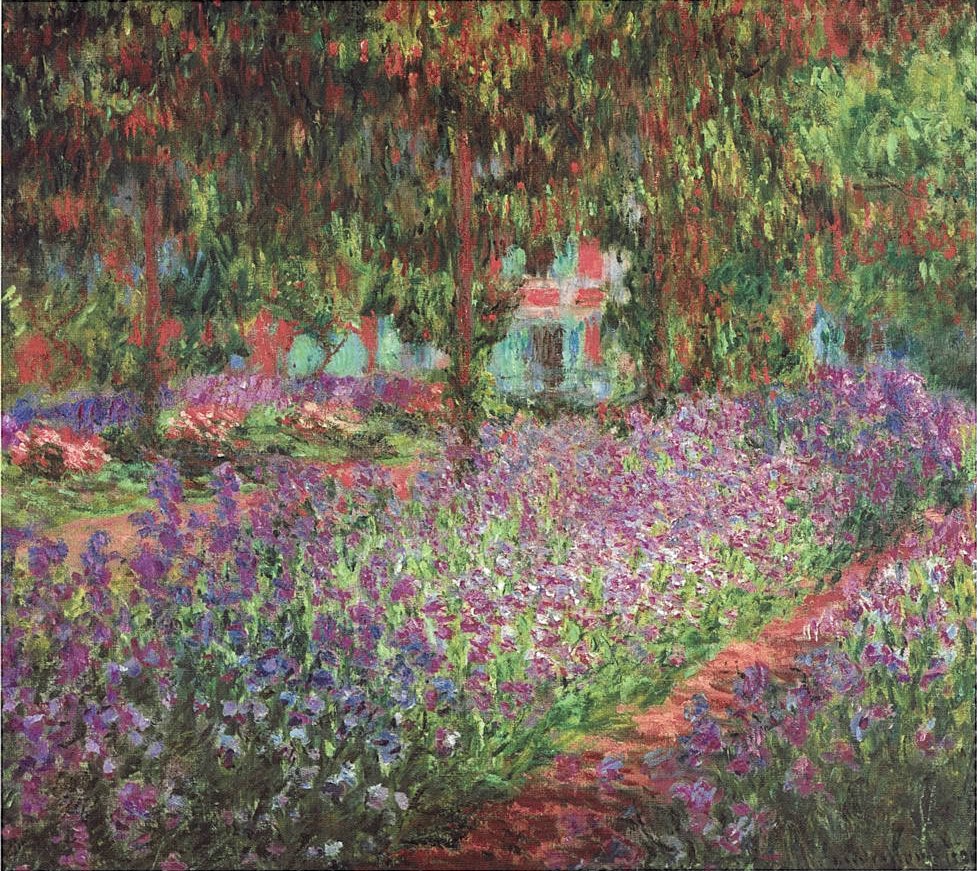
Picture: Claude Monet (1840 – 1926): Garden at Giverny (1900); Paris, Musée d‘Orsay (Wikimedia Commons)
 Planet Literature
Hinterlasse einen Kommentar