
Poems from Charles Baudelaires Collection of Poetry Les Fleurs du mal/7
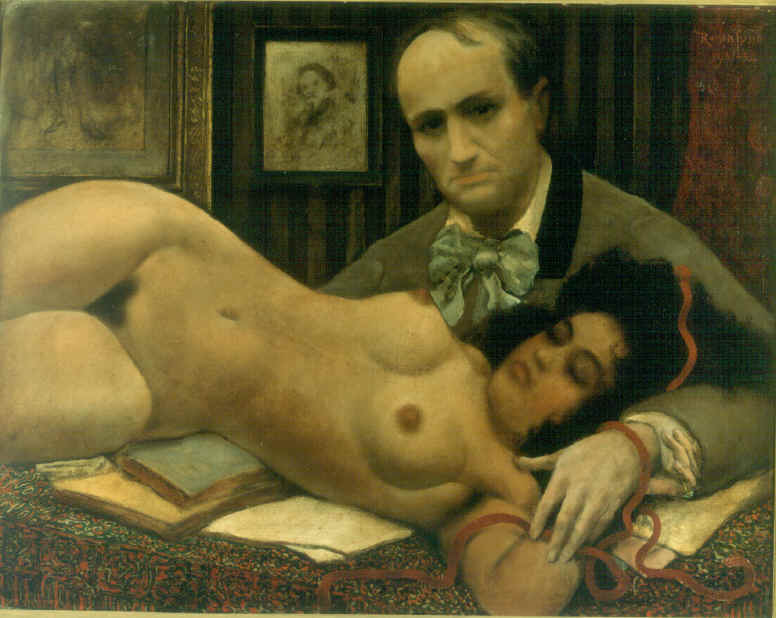
The representation of female figures in Baudelaire’s work is distinctly ambiguous. The woman can appear as a man-eating femme fatale, but also as an angel-like being who promises salvation from the valley of earthly life.
An Ambivalent Image of Women
Baudelaire’s relationship to women was highly ambivalent. On the one hand, they appear again and again in his poems as predatory beings who threaten to destroy men with their power of seduction and to drag them down into the abyss of desire. In Baudelaire’s case, this projection of his inner passions onto the female body has a tragic background: the poet fell ill with syphilis at an early age, which probably played a crucial role in his early death.
On the other hand, Baudelaire repeatedly transfigures the woman into a goddess who shows her disciples a way out of the valley of earthly suffering:
„The woman is unquestionably a guiding star. Her gaze, her words are an invitation to happiness; but above all, she represents a general harmony, not only in her way of walking and in the movement of her limbs, but also in the muslin robes, the veils, the vast and iridescent clouds of cloth in which she wraps herself and which are like the attributes and the pedestal of her divinity; in the metals and the minerals that wind around her arms and neck, that murmur softly at her ears, and whose sparks intermingle with the fire of her looks“.
The Woman as a Projection Screen and a Source of Inspiration
On the level of social reality, of concrete interpersonal relations, such a glorification of female nature has the opposite effect of what it seems to aim at. Instead of giving women the greatest possible influence on social life, so that they can resolve its dissonances with their god-like powers, men exclude them from participating in the „dirty“ social life. From this perspective, the man is a kind of knight of everyday life who death-defyingly strives to earn a living, whereas his noble wife, too good for this world, looks after house and hearth.
However, in Baudelaire’s case, the woman is hardly idealised as a holy housewife. Rather, she appears as a kind of muse who is both a projection screen and a source of inspiration for poetic intuition. Consequently, Baudelaire associates her with the perfect harmony to be found in nature:
„She is the reflection of all the grace of nature concentrated in a single being. She is an object of admiration and of the most intense curiosity that the image of life can arouse in the beholder“.
The representation of female figures in Baudelaire’s work is thus distinctly ambiguous. On the one hand, the woman, as a man-eating femme fatale, can serve as a projection screen for those urges that bind the ego to the dark valley of this world. On the other hand, she can also appear as an angel-like being who promises salvation from this valley. This enigmatic appearance of the woman, however, is precisely what gives rise to the elusiveness that makes the feminine a favourite subject of poetic expression.
To a passing woman
Surrounded by the shrieking noise of the street,
I saw a woman in grief passing by,
like a queen in her pain,
majestically holding the hem of her gown,
like a statue crossing the sea of the crowd.
And I, enraptured, drowned in the spell of her eyes,
in that gloomy sky where tempests germinate
and the passion capable of killing.
A flash … and suddenly: night! – Elusive Beauty,
whose gaze gave me new birth:
Will our paths ever cross again?
Elsewhere? Far from here? Never?
Where have you gone, you whom I would have loved?
Now we shall only meet in eternity.
Charles Baudelaire: À une passante from: Les Fleurs du mal (The Flowers of Evil; 1857), p. 270. 1868 (Œuvres complètes / Complete works, vol. 1)
Musical settings:
Frànçois Atlas (Frànçois and the Atlas Mountains):
Bertrand Louis (from the album Baudelaire, 2018):
Quotations taken from Charles Baudelaire: Le peintre de la vie moderne (The Painter of Modern Life; 1863). In: Baudelaire, Œuvres completes (Complete works), vol. 3, pp. 51 – 114; ch. X: La femme (The woman), pp. 96 – 99. Paris 1885: Calmann-Lévy.
Picture: Armand Rassenfosse (1862 – 1934): Baudelaire and his muse [Jeanne Duval]; c. 1920 (Wikimedia Commons)
 Planet Literature
Hinterlasse einen Kommentar