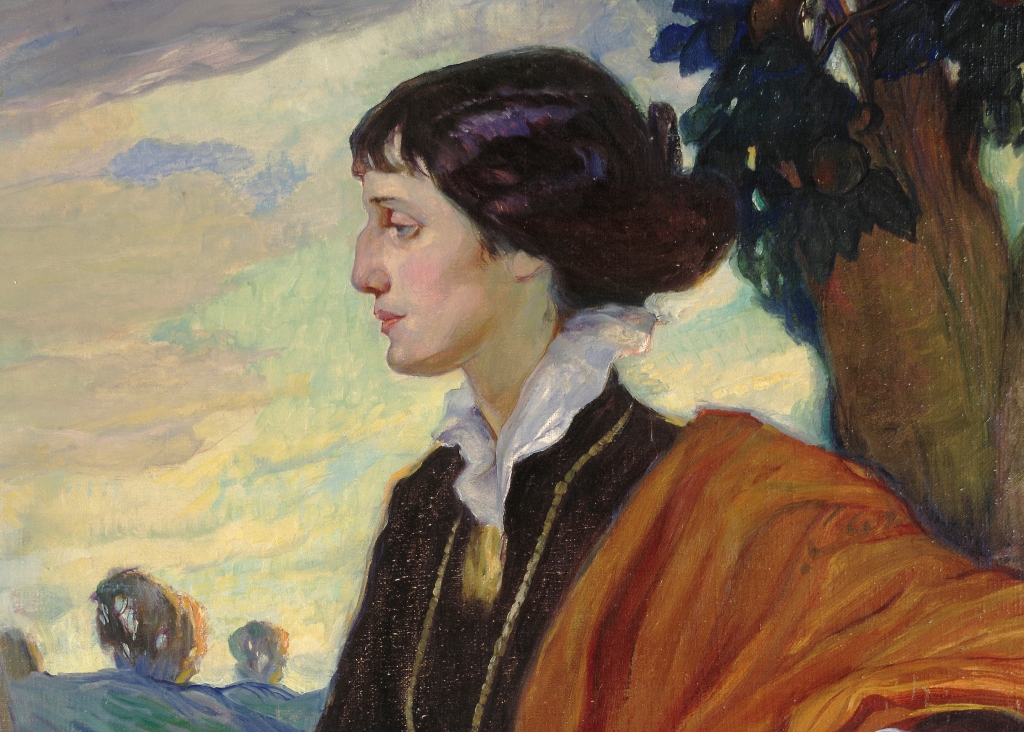
During the time of the Stalinist Purges, Anna Akhmatova was, like many others, subjected to repression. Especially the difficult prison conditions of her son drove the poet to the edge of madness.
The Fiend of Madness with his gloomy wings
already shadows my soul’s land.
He pours burning wine into my veins
and lures me into his dark valley.
I know he will be the victor,
the fortress of my mind is too weak.
My own musing already seems to me
like the fluttering of a foreign frenzy.
In vain are my child-like imploring
and my fervent prayers.
I know there’s no way to appease him:
He will carry me off to his realm.
Only food for his fire are
the day the tempest seized us,
my son’s eyes, nightmarishly dark,
frozen words in the prison yard.
Still I can feel the trembling of his hand
in mine, like a faded raven’s feather,
and the echoing whisper of comfort
in the flickering shade of the lime tree.
Anna Ackmatova: Poem no. IX (1940); from the cycle Реквием (Requiem; 1934 – 1963); English adaptation
An Ostracised Poet
After the October Revolution, Anna Akhmatova, until then a renowned poet, was quickly marginalised. Her poetry did not fit in with the „proletarskaya kultura“ proclaimed by the new rulers. After her first husband, Nikolai Gumilyov, was shot as an alleged counter-revolutionary, she herself was subjected to increasing harassment by the authorities.
Akhmatova’s life after the Bolshevik Revolution could have been more tranquil, though. After her divorce from Gumilyov in 1918, the artisan Boris Anrep offered her the opportunity to emigrate with her to a Western country. She refused, however, because she did not want to live permanently outside her homeland.
Living in Difficult Circumstances

Instead, she began a relationship with a literary critic who died of tuberculosis shortly afterwards. Her four-year marriage to the assyrologist Vladimir Shileyko, who was critical or even hostile towards her poetry, was also decidedly unhappy.
Her marriage to the art historian Nikolai Punin, with whom Akhmatova entered into wedlock in 1925, seems to have been privately happier. However, the circumstances in which the couple lived were decidedly difficult.
Marginalised as intellectuals in the new state, they could not afford their own flat and instead had to live in a Kommunalka with Punin’s ex-wife. They lacked the most basic necessities, even food was scarce, so that Akhmatova later referred to this period as her „vegetarian years“ in bitter irony.
Persecution at the Time of the Stalinist Purges
What bothered Akhmatova the most, however, was the persecution to which her husband and son had been subjected since the 1930s. In keeping with the usual practice during the Stalinist Purges, this was not a matter of specific anti-state activities. As in the case of Akhmatova’s son Lev, it was enough to be the descendant of a father who had been shot for alleged anti-Bolshevik activities.
After being denied access to study, Lev was eventually imprisoned and even sentenced to death. Unlike her husband, who died in a labour camp in 1953, Akhmatov’s son did escape death. But his mother had to be constantly prepared for the death sentence to be carried out.
Desperate Struggle for the Life of Her Son
Apart from this exceptional emotional situation, the mere physical fight for her son’s life was a tremendous challenge for Akhmatova. Relatives of detainees had to queue for hours before they were allowed to see them and bring them food or warm clothes.
On top of that, Akhmatova herself lacked the means for this. She had to go hungry herself and beg from acquaintances to keep her son from starving.
The poem reproduced above tells of the despair that apparently often gripped the poet in this hopeless situation. It is part of a cycle entitled Requiem, in which Akhmatova deals with her experiences during the time of the Stalinist terror.
All Posts about Anna Akhmatova in one PDF: Anna Akhmatova and the Russian Soul
Images: Olga Della-Vos-Kardovskaya (1875 – 1952): Portrait of Anna Akhmatova (1914); Moscow, Tretyakov Gallery (Wikimedia Commons); Detail from a photo showing Anna Akhmatova together with the actress Olga Glebova-Sudejkina; before 1917 (Wikimedia commons)
 Planet Literature
Hinterlasse einen Kommentar