
Mariee Sioux: Wizard flurry home
In winter the outer life comes to a standstill. But it is precisely this what opens the door to inner transformation for us.
As the other side of life, winter is the place of death. At the same time, however, its otherness can be understood in the sense of a counter-concept, a „counter-world“ in which everything that is unthinkable in real life seems possible. The winter world itself invites us to such thoughts. Although winter stands for the total absence of life, it seems to imitate life. Snow drifts pile up the ice masses to bizarre landscapes, icicles remind us of the cones of conifers, hoarfrost covers the land as if with a blanket of glittering ice flowers.
It is precisely because winter seems to imitate and alienate life at the same time that it provides the basis for dreams of another world. This is all the more true when it envelops the world in a veil of snowflakes. By hiding, transforming or „fragmenting“ the usual appearances of things in a snowflake whirl, winter enables us to detach ourselves from our habitual view of the world. It thus opens our mind to a state of contemplative contemplation, which is the fundamental precondition of all mystical experience.
This is also the basis of the song Wizard flurry home by the Californian singer-songwriter Mariee Sioux. Her father is of Polish-Hungarian origin and sometimes accompanies her with his mandolin. Her mother has Spanish roots, but also belongs to the Paiute people. The artist, born in 1985, expresses this musically by integrating traditional Indian-Mexican flute sounds into her music.
With regard to content, the song refers in particular to the cultic dances of the Paiute, in which a state of trance was to be achieved with the help of ritual drum sounds. At the end of the 19th century, this form of music also took on a political-revolutionary meaning in the so-called „ghost dance movement“. Here the dances were intended to bring about visions that would show the dancers the way to liberation from the white occupying power.
Mariee Sioux’s song alludes to this insofar as it evokes a „dancing into pieces“ of the world by a drumming magician or medicine man. The liberation to be attained through this, however, is not – as hoped for by the ghost dance movement – an external one, but takes place on the inner level, in the sense of an individual initiation into the mystical world of the ancestors.
This becomes clear, for example, in the symbolic meaning of the number five in the poem. It obviously stands for perfection or completion (in the sense of the five fingers of a hand). Thus the „breaking in two“ of the heart the text speaks of is not to be understood in the sense of a destructive breaking apart, but in the sense of discovering another, hitherto unknown side of one’s own existence. Its central characteristic would be the abolition of isolation and the unison with the one, all-pervading breath of life, as indicated by the all-encompassing snow shower.
In connection with the psychedelic music, the associative text conveys an idea of precisely that „magical“ mood to which the title of the song refers. The dissolving sentences, through which the sound quality of the words comes to the fore in relation to the semantic level, also fit well with the described situation of a world falling apart into the mosaic of dancing snowflakes.
Mariee Sioux: Wizard flurry home; from the album A Bundled Bundle of Bundles (2006)
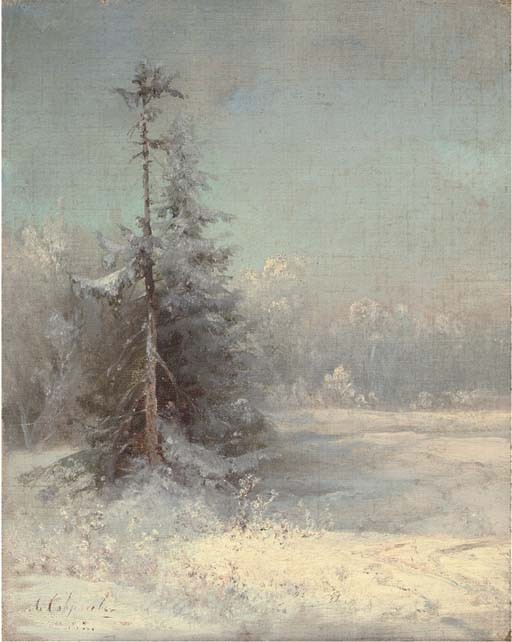
Image: Alexej Sawrassow (1830 – 1897): winter landscape.
 Planet Literature
Hinterlasse einen Kommentar