
Vladimir Vysotsky’s song Bratskiye Mogily (Mass Graves)
The poem Mass Graves by the Russian guitar poet Vladimir Vysotsky, written in 1963, referred at the time to Russian victims in the Second World War. Today, however, we associate it with mass graves caused by Russia itself.
No crosses can be seen on mass graves,
here you don’t hear widows crying.
Only flower bunches wither in the sun,
a grave light tells lies of eternity.
The earth, once a cornucopia of life,
is smothered here by slabs of stone.
The single lives, colourful and unbound –
one fate binds them to this place.
Immersed in the flickering grave light,
you stare at burning cities,
burning houses and parliaments,
burning soldiers‘ hearts.
No, there are no widows crying here.
Hardened are the hearts of those
who stand here in silence, no cross
breaks through this desert of death.
Владимир Высоцкий (Vladimir Vysotsky): Братские могилы (Bratskiye Mogily)
Album version on useraudio.net
Live on YouTube
CONTENT
The Song between War Commemoration and Militaristic Patriotism
Vysotsky’s Ambivalent Attitude Towards War
A Strange Birthday Serenade
Moscow, June 22, 1963: Birthday party for Semyon Vysotsky, the father of Vladimir Vysotsky. The „zakuski“, the sumptuous appetiser buffet, has long since been cleared, even the second dish is coming to an end. Before the birthday cake is served, Vladimir Vysotsky, then 25 years old, stands up and serenates his father with the song „Bratskije Mogily“ (Mass Graves, literally „Brotherly Graves“), which he has just written.
A mood killer? Didn’t his father, a Red Army officer, have to take the song as an insult?
The answer is a double „Nyet“. In Russia it is quite common to stir a good dash of sentimentality into the party soup at an advanced hour with appropriate songs. And of course, those present at the performance were not thinking of the mass graves resulting from the Stalinist terror at the time of the „Great Purge“ in the 1930s.
Likewise, the mass graves in other countries will not have been high on the list of associations – as for example the mass graves in Ukraine that followed the ruthlessly enforced collectivisation in agriculture in the early 1930s. The Ukrainian trauma of the „Holodomor“ (death/extermination by hunger), which is being terribly continued in the current mass murder in Ukraine, was probably not present in the minds of the celebrating community back then.
No, those present at the time will have been thinking above all of their own sacrifices, the victims the Russian people had to mourn in the „Great Patriotic War“ against Nazi Germany. Vysotsky’s father was thus indirectly honoured by the song as a hero who had been prepared to defend his homeland even by sacrificing his own life if necessary.
The Song between War Commemoration and Militaristic Patriotism
However, the fact that the song was well received at a birthday party did not mean that it could also pass Soviet censorship. The reason for this was the official party doctrine, which did not focus on the suffering of the fallen and their survivors, but on the triumphant frenzy following the victory in the war. Against this backdrop, Vysotsky’s song came under suspicion of undermining military morale.
Nevertheless, the song soon found its way into the public domain thanks to the film Я родом из детства (Ja rodom s djetsvo – I come from childhood, 1966). This was a kind of Soviet coming-of-age film: two boys living in a town near the front have to face the suffering of war while at the same time searching for their own place in life.
Vysotsky’s song about the mass graves suited this film so well that the director, Viktor Turov, wanted to integrate it into the plot. This was initially forbidden by the censorship authorities, but in the end a compromise was found. The director was given permission to include the last two strophes of the song in the film, albeit in the version of a different performer.
In this way, the song gained great popularity, unlike most of Vysotsky’s other songs, was subsequently allowed to be performed and distributed in public.
Vysotsky’s Ambivalent Attitude Towards War
With its integration into a patriotic film, the song testifies to Vysotsky’s ambivalent attitude towards war. Although he certainly was not a supporter of Soviet militarism, he was not a pacifist either. This is also expressed in the different versions of Bratskije Mogily. Some emphasise more the patriotic aspect of sacrifycing one’s own life, others rather the suffering of those left behind.
In view of the current situation, in which the Russian army itself is sowing mass graves in a neighbouring country, any patriotic undertone is, of course, out of the question. I have therefore deliberately chosen a very free English adaptation of the text, focusing on the horror of the mass graves, which is beyond the capacity of human suffering.
Short Biography of Vysotsky
Vladimir Vysotsky attended the acting school of the Moscow Art Theatre after leaving school. From 1964 he worked at the Taganka Theatre in Moscow and at the same time began a career as a film actor.
Vysotsky also used the popularity he gained in this way to disseminate his poems. Set to music, some of them found their way into films in which the author took part.
Of course, there were also songs that Vysotsky – like other guitar poets – could only perform in small circles. His works were not consistently critical of the regime, but they repeatedly put their finger in the wound of social taboos. One example of this was Soviet anti-Semitism, which the singer – as the son of a Jewish father – probably knew from his own experience.
As an actor, Vyssotsky’s star role was Hamlet. In his view, the tragedy of Hamlet consisted in the compulsion to follow a course of action that is rejected in one’s innermost being. This includes not being able to break away from conventions that, for example, make violent forms of conflict resolution acceptable.
Far from being averse to alcohol and cigarettes, Vysotsky died at the early age of 42. Although not reported in the state media, his death provoked a nationwide wave of mourning.
Links
The history of the song Bratskije Mogily is documented on song-story.ru (Russian). The website also provides links to the different versions of the song, including the version from the film Ja rodom s djetsvo (I come from childhood).
More on Russian guitar poetry in RB: Der Krieg als Verrat am Selbst. Antikriegslieder in der russischen Gitarrenlyrik (The war as a betrayal of the self. Anti-war songs in Russian guitar poetry; German); rotherbaron.com, March 2022.
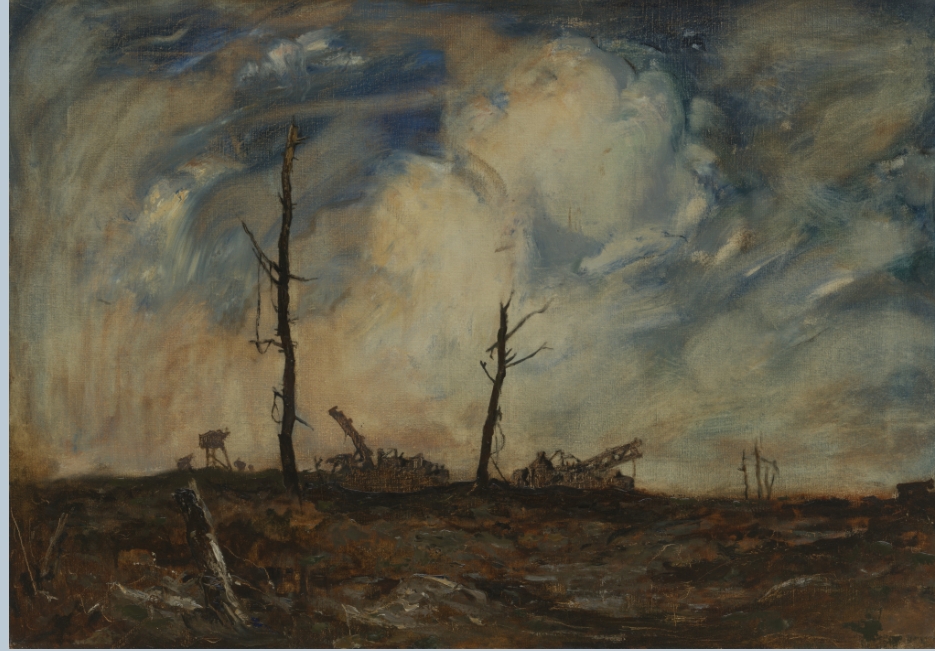
Image: Adrian Hill (1895 – 1977):Ruins between Bernafay Wood and Maricourt (1918); London, Imperial War Museums (Wikimedia Commons)
 Planet Literature
Hinterlasse einen Kommentar