
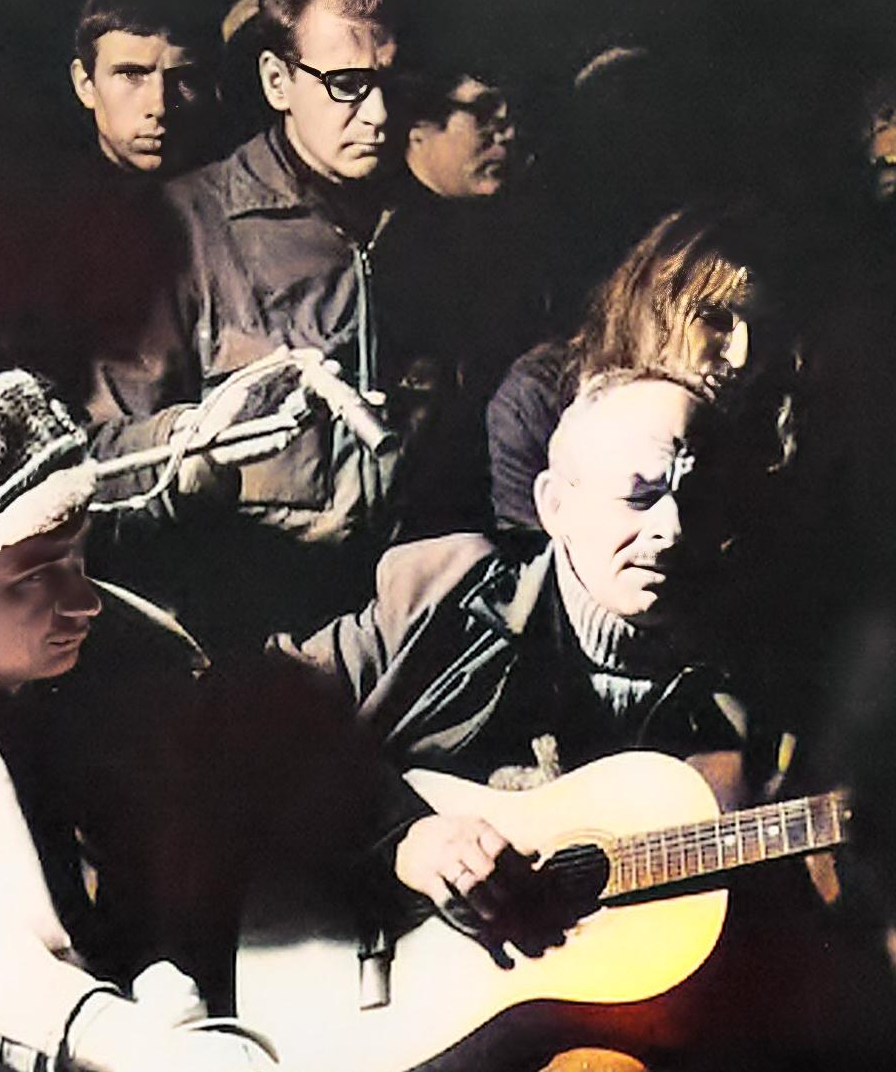
Bulat Okudzhava’s Little Song About My Life.
While the Soviet leadership was trying to secure peace through repression and nuclear weapons, intensive discussions were taking place in dissident circles about the mental prerequisites of war and peace. This is also reflected in Bulat Okudzhava’s Little Song About My Life.
Bulat Okudzhava (1924 – 1997) is considered one of the most important representatives of Russian guitar poetry. As he himself explains, guitar poetry was „born in Moscow kitchens“ in the 1950s and 1960s, where it was performed „in a close circle of like-minded people“. With its „claim to (…) think independently and openly express its rejection of orthodox ideology,“ guitar poetry, according to Okudzhava, has unleashed an „explosive charge of civil courage.“ For this reason, it was „persecuted by power, but revered by the persecuted“ (Okudzhava 1992, p. 7).
Okudzhava’s poem in question here is based on a juxtaposition of the ecstasy of love and the ecstasy of war: just like some people rush headlong into the first love, we may also initially affirm the war out of an adolescent-passionate heroism. In this sense, the „first war“, like the „first love,“ simply ‚happens‘ without anyone being to blame for it.
But if the war continues, if the first act of war leads to further acts of war so that the war becomes a permanent state of being, this can no longer be downplayed as a short upsurge of emotions in a quarrel between friends. Since the war must then be deliberately fomented, concrete culprits can be identified. If this does not happen and the war nevertheless continues or establishes itself as a belligerent attitude on the part of the state, it is the fault of each individual if they do not oppose it.
These reflections are directly linked to the third stanza, which is about „obman“. Literally, this means „fraud“. In the context of the poem, however, it is more likely to be understood in the sense of self-deception, which leads to betrayal of oneself and one’s own ideals. Again, parallels can be drawn to love: A love that does not become aware of itself – and thus does not mean the concrete other on whom it ignites – becomes self-love and thus self-deception or betrayal of oneself and others.
The same applies to an approach to war that remains on an emotional-pubescent level and does not realise the long-term consequences of the spiral of violence. This, too, appears as a betrayal of oneself and of the ideal of humanity. In the beginning, this self-deception may be due to a small, excusable weakness, an inebriated state and the resulting „drunken staggering“. As a permanent state, however, it is „more terrible than war“, since it makes its domination possible in the first place.
Булат Окуджава: Песенка О Моей Жизни (Pyesyenka o moyey zhizni, 1957 – 1961)/ Bulat Okudzhava: Little Song about my Life (And the first love …)
Poem sung by Okudzhava and Russian text
Translation
And the first love – it burns the heart.
And the second love – it snuggles up to the first one.
Well, and the third love – the key trembles in the lock,
the key trembles in the lock, the suitcase is in the hand.
And the first war – it is nobody’s fault.
and the second war – it is somebody’s fault.
And the third war – it is all my fault,
and my fault – it is plain for all to see.
And the first betrayal – fog in the twilight.
And the second betrayal – drunken staggering.
And the third betrayal – it is darker than the night,
it is darker than the night, it is worse than war.
Okudzhava quote taken from:
Okudzhava, Bulat: Geleitwort. In: Lebedewa, Katja: Komm Gitarre, mach mich frei! Russische Gitarrenlyrik in der Opposition, S. 7 f. Berlin 1992: edition q.
[Foreword. In: Lebedeva, Katya: Come on, Guitar, Set Me Free! Russian Guitar Poetry in Resistance, p. 7 f. Berlin 1992: edition q.]
Picture: Bulat Okudzhava with audience, 1976 (in the background Vladimir Vysotsky)
 Planet Literature
Hinterlasse einen Kommentar