

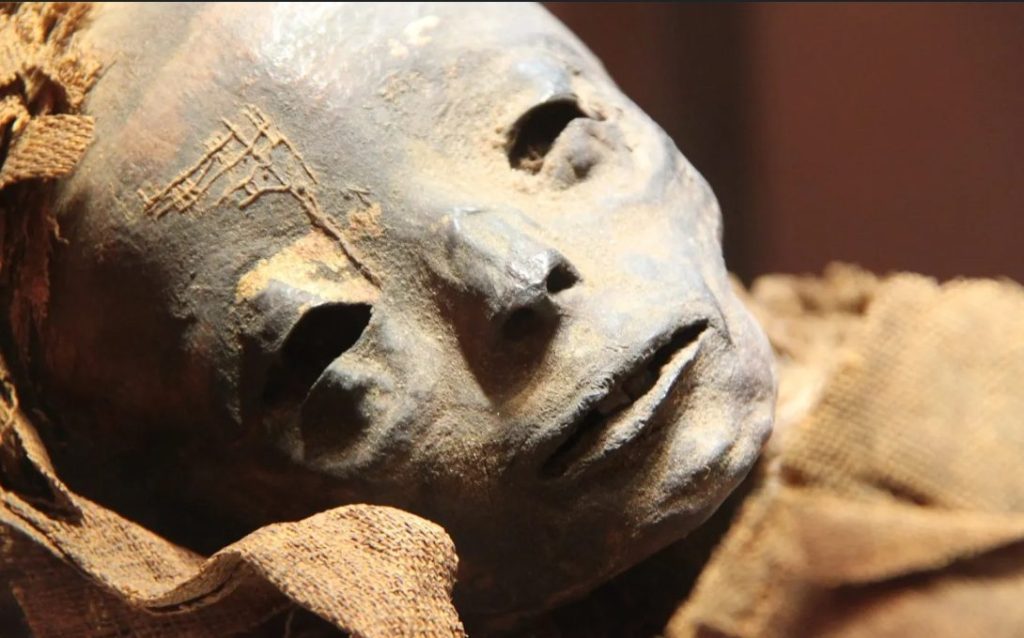
On Antonin Artaud’s Poetic Revolt, Exemplified by his Poem Invocation à la Momie (Invocation of the Mummy)
The French poet and playwright Antonin Artaud (1896 – 1948) dreamed of transforming the world through poetry. His own life, though, was anything but „poetic“.
Invocation of the Mummy
The bone caves of your nostrils
open into undivided darkness,
a strange realm of shadows looms
behind the curtain of your lips.
Life, that relentless bone eater,
bestows upon you a dream of gold,
a deceptive floral wink
that reconciles you with the light.
And your spindle fingers, mummy!
grope for your entrails,
those fingertips whose Hades shadows
flutter as ravens on the wall.
The shady ornament of death,
born of a roll of the dice,
flickers like a silent scream
around the golden dungeon of your heart.
The frozen road of your veins
unites us, mummy! as brothers and sisters;
this gold that sprinkles sparks of life
mockingly on the orphaned body.
Antonin Artaud: Invocation à la Momie
In: Poèmes 1913 – 1935 (PDF), here: Poèmes 1924 – 1935, S. 90. Bibliothèque numérique romande, ebooks-bnr.com.
Artistic and Existential Border Crossings
Experience of Institutionalised Violence in Psychiatry
Artaud’s Cathartic „Theatre of Cruelty“
The Vision of a „Body without Organs“
The Liberating Power of Poetry
Unification of Mortality and Transcendence in the Mirror of the Mummy
An Act of Censorship
On February 1, 1948, a veritable case of censorship occurred in France. One day before the scheduled broadcast date – and one month before the death of the 51-year-old author –, Vladimir Porché, the director of Radiodiffusion française (RDF), prohibited the broadcast of the radio play Pour en finir avec le jugement de dieu (Putting an End to the Judgement of God) by Antonin Artaud (1).
To the director’s credit, we have to admit that the radio play was quite out of the ordinary in some respects. Far from offering edification or telling a pleasing story, it aimed to disturb the audience instead. The sentences were repeatedly interrupted by loud screams, drumming, unmotivated laughter or nonsense words. In addition, the sound tracks partially overlapped and thus deliberately contradicted the traditional processes of reception. So the idea suggested itself that the listeners might be overstrained by this.
On the other hand, it must be conceded that Artaud had every reason to reject any consideration for the sensitivities of the audience and to express his scepticism towards conventional forms of artistic representation. When he set about realising the radio play, he had spent almost nine years forcibly in a psychiatric ward while unimaginable orgies of violence raged outside. From his point of view, this virtually demanded a radically different, stirring style of expression.
Artistic and Existential Border Crossings
However, Artaud had not exactly orientated himself towards traditional forms of artistic expression even before he was committed to a psychiatric ward. Like the Surrealists, whose movement he had joined for a time from 1920 onwards, he strove to open up art to new forms of expression in order to allow a new view of reality and to bring repressed psychic content to consciousness. In this, he was in line with André Breton, the founder of Surrealism, who had proclaimed in his first Surrealist Manifesto in 1924:
„I believe in the future dissolution of these seemingly so contradictory states of dream and reality into a kind of absolute reality – a surreality, so to speak.“ (2)
For Artaud, however, the blurring of the boundaries between dream and reality had a very concrete meaning. After a meningitis in early childhood, he suffered from chronic neuritis throughout his life. This had driven him into drug addiction at an early age. In addition to opium and heroin, he also consumed peyotl, a narcotic derived from a cactus plant.
Artaud had become acquainted with peyotl in 1936 during a ten-month stay with the Mexican Tarahumara. The experiences he made under the influence of the drug encouraged him to leave behind the conventional view of reality and of his own ego:
„The peyotl leads the ego to its true sources. When you awake from such a vision, you can no longer confuse the lie with the truth as you did before. You have seen where you come from and who you are, and you no longer doubt what you are.“ [3]
Experience of Institutionalised Violence in Psychiatry
However, precisely that other reality into which Artaud crossed over after his inebriating experiences in Mexico proved incompatible with bourgeois everyday life. Moreover, the journey from the Mexican jungle to the Irish druids, which he embarked on after his stay with the Tarahumara, might have been a mental overload for him.
In any case, this journey ended with the author’s homelessness in Dublin and his expulsion from Ireland. This was followed in France by committal to a psychiatric ward, where Artaud had to endure the whole range of institutionalised cruelty. In addition to insulin therapy, he was also subjected to electric shocks. As Artaud reports, these were also used as punishment if the patient objected to drug withdrawal:
„Dr. F., chief physician of the Rodez asylum, confiscated from the wardress 1 gram of heroin which she wanted to bring me, (…) and imposed on me four sequences of electric shocks, that is, 40 comas added to the 10 already preceding, to which he subjected me because I asked him for 25 drops of laudanum [tincture of opium].“ [4]
Artaud’s Cathartic „Theatre of Cruelty“
In a certain sense, Artaud’s experiences in psychiatry can be seen as a retrospective confirmation of his most famous idea: the „théâtre de la cruauté“ (theatre of cruelty). After all, the declared aim of the latter was precisely to raise awareness of the forms of structural violence that Artaud had to experience in psychiatry and thus ultimately to overcome them [5].
To achieve this goal, the Theatre of Cruelty refuses any form of bourgeois enjoyment of art. Instead, the violence in everyday societal life is to be made tangible. By experiencing this violence in an exemplary way, a kind of catharsis should be brought about that leads individuals to rethink their behaviour and thus, in the long run, initiate changes on the level of society as a whole. In line with this goal, Artaud also referred to the form of theatre he envisioned as „alchemical“ or „metaphysical“ – and thus emphasised the mental changes that were to be achieved through it [6].
In order to ensure an immediate impact, the Theatre of Cruelty was also intended to have a different seating arrangement. The audience should no longer be able to cower in the darkness of the theatre, but be included in the play. Instead of sitting opposite the actors, Artaud wanted to arrange the stage in a circle around the audience.
Another important feature of the Theatre of Cruelty is a new understanding of language. Instead of merely presenting someone else’s linguistic construct for performance, the theatre itself was to speak to the audience. The aim was to „break through the theatre’s subjection to the text and to rediscover the concept of a kind of language between gesture and thought“ [7].
To this end, Artaud wanted to make greater use of non-verbal means of expression, such as non-verbal sounds, non-human tones and a specific use of lighting. Furthermore, Artaud – who was inspired in this by Balinese theatre – also used the actors themselves as „hieroglyphs“ [8]: Through their performance, they were to create their own non-verbal language.
The Vision of a „Body without Organs“
With the „Theatre of Cruelty“, Artaud also connects the approach to another ideal that at first glance might appear strange: that of a body without organs. The basic idea here is that the organs are indispensable for maintaining life, but that at the same time they bind people to an existence in which they are not at home. Or more precisely: from which they are already expelled at birth by the death sentence imposed on every human being:
„Organs were created only to nourish beings, while these were condemned in principle and have no right to exist.“ [9]
Against this background, the Theatre of Cruelty is intended to bring about not only a social but also an existential liberation. It is supposed to create a new reality „through a new dance of the human body“ [10], in which the existence of the body is no longer based only on material organs, but also on spiritual organs. The central characteristic of these would be a complete independence that relates to both the material and the previous spiritual existence of humanity.
This is expressed in detail by Artaud in a passage from the radio play Pour en finir avec le jugement de dieu (Putting an End to the Judgement of God) quoted above:
„Man is sick because he is badly constructed. We must uncover his inner life, to scrape off this little animal that makes it impossible for him to live a tranquil life: God – and with God, his organs. For nothing will dissuade me from my conviction that there is nothing more useless than an organ. If you provide man with a body without organs, then you will have freed him from all his automatisms and given him back his true freedom. Then he will learn to dance on his head again, as in the frenzy of the ballrooms, and this dancing will show him his true place in the world.“ [11]
The Liberating Power of Poetry
Of course, a body without organs is and remains a paradox. A body without organs is basically – nothing.
Naturally, Antonin Artaud was aware of this fact as well. As early as 1925, he stated:
„One must know the true, rejuvenating power of nothingness, the nothingness that no longer has an organ.“ [12]
The affirmative reference to nothingness, which appears here like a fountain of youth, has clear echoes of mysticism, in which nothingness, across all religions, is a symbol of liberation from the prison of material existence. However, this liberation is in no way religiously connoted in Artaud’s work. Instead, he associates liberation from material organs with the birth of a being completely imbued with poetry [13].
The romantic impulse to transform the world and one’s own self with the help of poetry is thus accompanied in Artaud’s work by the idea of both spiritual and social liberation.
Unification of Mortality and Transcendence in the Mirror of the Mummy
Against this background, Artaud’s Invocation à la Momie (Invocation of the Mummy) can finally be appropriately understood. After all, the mummy represents precisely the ideal that Artaud dreams of: that of a body without organs.
On the surface, the mummy testifies to the price that has to be paid for such a form of existence: that of the irreversible end of physical existence. Nevertheless, Artaud’s poem paints the picture of a cadaver that is filled with secret life in many ways.
As a result, a Janus-faced image enfolds: From the perspective of the person looking at the mummy, it points ahead to the gloomy fate that inevitably awaits every human being. From the perspective of the mummy, on the other hand, death appears as a curtain behind which life continues as in a shadow play. In the mirror of the image the beholder creates of her, she lives on in a macabre way.
In the Invocation of the Mummy, Artaud thus combines man’s condemnation to death with the symbolic overcoming of it. The spiritual „organ“ that makes this transcendence possible is, in accordance with Artaud’s poetic revolt – poetry.
References, Notes, Links
- The original version of the radio play is available on the web: Pour en finir avec le jugement de dieu (November 1947). In Artaud’s Collected Works it can be found in volume 13: Oeuvres complétes, tome 13, Paris 1974: Gallimard. The Collected Works comprise a total of 26 volumes and were edited by Paule Thèvenin between 1970 and 1994.
- Breton, André: First Manifesto of Surrealism (1924). In: Breton, Manifestoes of Surrealism (French 1962, German 1968), pp. 9 – 43 (here p. 18). Reinbek 1986: Rowohlt. French original: Manifeste du surréalisme.
- Artaud, Les Tarahumaras (Oeuvres Complétes X, 34); here quoted after Schlutz, Alexander: „Es ist hart und schwer, mich zu lieben“. Jenseits von Kunst und Kultur: Antonin Artaud („It is hard and difficult to love me“. Beyond Art and Culture: Antonin Artaud. In: parapluie.de (no. 3, Winter 1997/98), p. 6 f. (in the PDF version of the article).
- Artaud, Oeuvres Complétes XIV/1, S. 137. Paris 1978; here quoted after ibid., p. 1 f. (PDF).
- Artaud summarised his reflections on the „theatre of cruelty“ in 1938 in the essay volume The Theatre and its Double (cf. Oeuvres complétes, tome 13); quoted according to the German translation (by Gerd Henniger), first published in 1969 by S. Fischer Verlag (reprinted in 2012 by Mathes & Seitz).
- Cf. Mattheus, Bernd: „The Theatre of Cruelty“. A Major Misunderstanding. In: Artaud, Antonin: Das Theater und sein Double. Das Théâtre de Séraphin, p. 271. Berlin 2012: Matthes & Seitz.
- Artaud, Antonin: The Theatre of Cruelty (First Manifesto), see (5), p. 95.
- Artaud, Antonin: On Balinese Theatre, see (5), p. 58.
- Artaud, Oeuvres complétes, vol. 13, p. 287. The passage is not included in the original version of the essay on the „théâtre de la cruauté“; French in the original.
- Ibid.
- Ibid., p. 104.
- Artaud, Oeuvres complétes, vol. 1, p. 87 („Il faut connaître le vrai néant effilé, le néant qui n’a plus d’organe“).
- Artaud, letter to Henri Parisot, Rodez, October 6, 1945; here quoted after De Simone, Cristina: La recherche du dernier Artaud et le développement à Paris de la poésie en action. In: Revue Sciences/Lettres, Mai 27, 2019: L’Écho du Théâtre 2. Literally, Artaud speaks of the „physical and actual materialisation of a completely poetic being“ („matérialisation corporelle et réelle d’un être intégral de poésie“)
Titelbild: ESD-SS: Ägyptische Mumie (Pixabay)


Kommentar verfassen