

Karolina Cicha & Spółka feat. Bart Pałyga: Białystok majn hejm
Jewish culture and music have left their mark on many areas of European life. Much of it, however, has been erased forever by Nazi barbarism. With her album Yiddishland, the Polish artist Karolina Cicha has made an attempt at musical revival.
Białystok, my Home
I haven’t given up hope
to return to the city where I was born,
to see my home again, my beloved home,
made of wood and bricks and clay.
But as soon as I close my eyes,
I see the gallows in the streets,
garbage, ruins and debris.
The fascists have destroyed you, Białystok,
my beloved hometown.
Białystok, I remember every street and every house.
Białystok, I miss you like a child misses its mother.
Białystok, you are my most beautiful dream.
Białystok, all my songs turn around you.
What is my greatest wish?
I want to dry my mother’s tears –
that is my greatest wish.
Białystok, you are my most beautiful dream.
How I would love to return to you!
Białystok, now I live entirely
in my songs about you.
In the window, it seems, are reflected
the pale glances of my mother.
I know she’s asking me for consolation,
she’s waiting, and she knows
that she will find salvation.
I see the most beautiful day dawning,
with new windows, roofs and doors,
the day of liberation, the day of renewal,
when we will weep with joy.
Białystok, I remember …
Karolina Cicha & Spółka feat. Bart Pałyga: Białystok majn hejm(Polish); from: Jidyszland / Yiddishland (2015)
The Jewish Past of Białystok
In 2013, Karolina Cicha, a singer, actress and literary scholar born in 1979 in Białystok (Eastern Poland), released the album Wieloma Językami (In Many Languages). On it, she presents, together with Bart Pałyga and the band Spółka, the music of the ethnic minorities native to the region around Białystok called Podlasia or Podlachia.
During her work on the project, Cicha also became aware of the rich tradition of Jewish music in Poland: Białystok was an important center of Jewish life before World War II. At the beginning of the 20th century, when the city belonged to Russia, as many as two-thirds of the inhabitants were Jewish. This changed only after the pogrom of 1906, which led to a massive wave of emigration among the Jewish population.
Her involvement with Białystok’s Jewish past inspired Cicha to dedicate a separate album to the Jewish music of the region. The result was released in 2015 under the title Jidyszland / Yiddishland. For the album, which she recorded again with the band Spółka, Cicha scoured archives and consulted with specialists in Hebrew and Yiddish. In the end, she selected 12 songs or poems that she either reinterpreted or set to music especially for the album.
Genesis of the Song
The first song on the album is entitled Białystok majn hejm (Białystok, my home / homeland) – not to be confused with the classic Białystok anthem of the same name. Written in 1942 by a Jewish refugee in Tashkent/Uzbekistan, the song looks back at the lost homeland from a distance. In memory, it once again evokes the old, Jewish Białystok.
The extermination of Jewish Białystok by the Nazis is mentioned, but contrasted with the idyll of the old streets and houses, for which the self longs back „like a child missing its mother.“ To this „mother“ – and perhaps also to the real mother left behind in Białystok – the promise is made to return one day and renew the destroyed Jewish life.
Special Features of Cicha’s Interpretation of the Song
What is special about Cicha’s interpretation of the song is that it satisfies the unfulfilled hope of renewal on the level of music. Cicha does not perform the song as it might have been sung at the time it was written. Instead, she combines elements of Jewish klezmer music with modern ethno-jazz.
In this way, the music does not seem outdated, but quite contemporary – and thus gives the Jewish culture to which it bears witness a place in today’s (at least musical) everyday life.
This approach is also taken up in the video clip for the song. Shot in black and white, it points out that most of Białystok’s Jewish life has been destroyed. At the same time, however, Cicha and Bart Pałyga, who accompanies her, bring Jewish culture back to life with their vibrant performance.
By playing music as they wander through the streets of Białystok, they reconnect the music – and with it the vanished culture – with the city’s contemporary everyday life. Simultaneously, interspersed images from the past and memory sequences with older people make clear what was lost through the National Socialist extermination.
Information about the music project and Karolina Cicha on culture.pl: Yiddishland – Karolina Cicha & Spółka
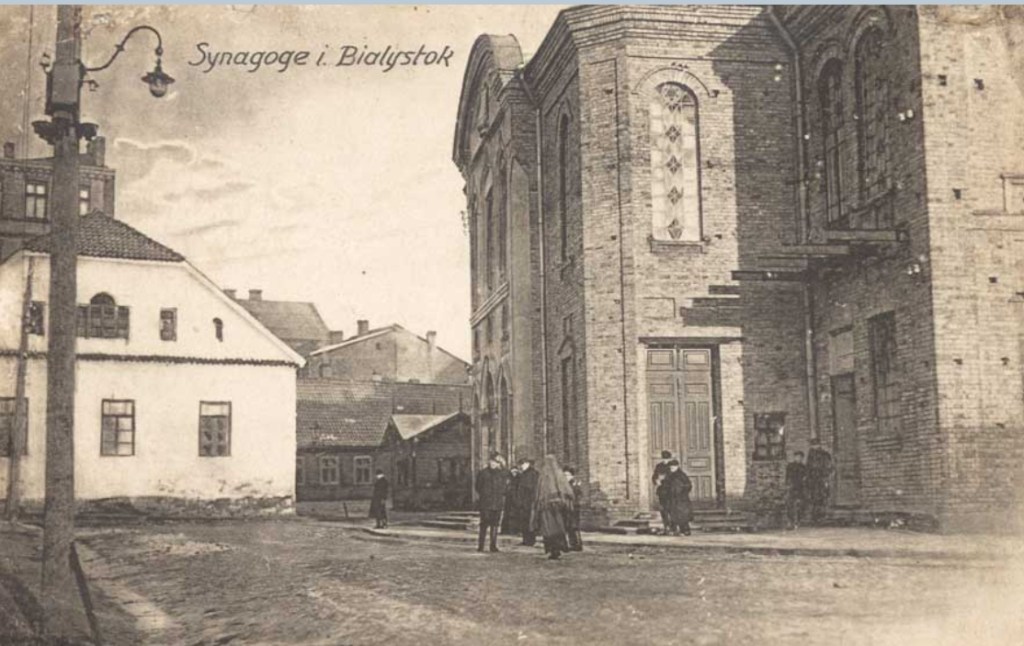
Title image: The synagogue of Białystok on a postcard from 1920


Hinterlasse einen Kommentar