

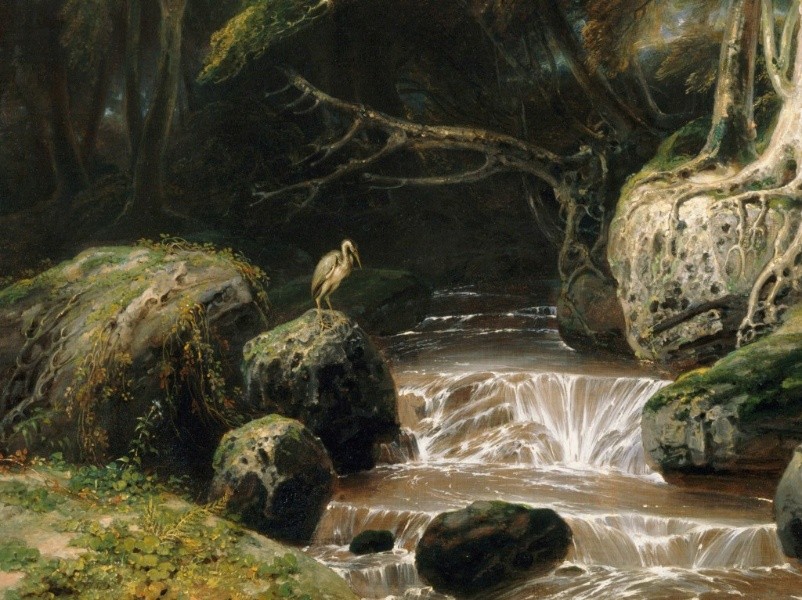
On Angelo Branduardi’s song La favola degli aironi (The Fairy Tale of the Herons)
n his song La favola degli aironi (The Tale of the Herons), Angelo Branduardi paints a remarkably peaceful picture of the apocalypse. In doing so, he illustrates that nature can manage perfectly well without humans – but humans cannot manage without nature.
The Fairy Tale of the Herons
There it is,
where the earth has bent down
to gather up all the things
that time has abandoned
and left behind.
There, where the restless wind
gnaws at the dunes,
the dunes with the ashy sand,
where now the ravens of winter
have settled down,
there it is,
where the horizon disappears.
There it is,
where even the last seed
hasn’t molted into a fruit.
There, where the earth has forgotten
that such a long time ago
the fragrant breath of the wind
moistened the iridescent wings of the herons,
there, where the ravens of winter
now darken everything,
there it is,
where the horizon disappears.
Angelo Branduardi: La favola degli aironi; from: Alla fiera dell’est (1976)
Lyrics by Branduardi and his wife Luisa Zappa Branduardi
Live recording from 1985:
Album version:
Peaceful Apocalypse
In his song, Angelo Branduardi depicts the situation after the ultimate apocalypse: The trees no longer bear fruit, the white sand of the beaches is permeated by the ashes of the vanished civilisation.
The atmosphere of the end of time is emphasised by correspondingly apocalyptic images. The clearest metaphor here is of course represented by the ravens, which darken the sky as messengers of death and make the iridescent wings of the herons seem like a fairy tale from ancient mythical times. In addition, the wind again blows across the earth as it did at the dawn of time. Instead of the promising fragrance of the blossoms, it now disseminates the lament about the downfall of the world.
As a matter of course, this pessimistic outlook is accompanied by subdued sounds. The amazing thing, however, is that the musical background of the apocalypse as a whole exudes a rather peaceful, comforting mood. It is almost as if Mother Earth, having swept up the rubble of human civilisation, is breathing a sigh of relief that she can now open a new chapter in her history.
Mother Earth and Humankind: Who Needs Whom?
Thus the song admonishes us not to confuse our own well-being with that of the planet we live on. The demise of our world is not synonymous with the demise of the entire world. To say it in the imagery of the poem: The very moment our horizon disappears, a new horizon will open up.
Mother Earth has already reinvented herself after much greater catastrophes than that of human civilisation running off the rails. She does not need us – we need her. Only if we learn again to listen to her language and tune our lives to the inherent laws of her development will we be able to find our way out of our current crisis.
About Angelo Branduardi
Born in 1950, the cantautore was trained as a violinist at the Niccolò Paganini Conservatory in Genoa and studied philosophy in Milan.
He gained international recognition as a musician when he combined elements of folk music with traditional song texts and fairy tales in the 1970s. For example, one of his best-known canzoni, Alla fiera dell’est, is based on the Jewish Pessah song Chad gadja (Little Lamb). Branduardi also took up the poem Under der linden („Under the Lime Tree“) by the minnesinger Walther von der Vogelweide in a song of the same title (Sotto il tiglio).
Another focus of Branduardi’s work is Renaissance music, to which he refers in numerous pieces. The accompanying texts sometimes have an explicitly religious nature. This is especially true of his album L’infinitamente piccolo from 2000, which is dedicated to St. Francis. His Church Tour, in the course of which Branduardi performed in several German churches in 2014, can also be seen in this context.
Due to the frequent references to fairy tales and legends, Branduardi’s lyrics often sound „fairy-tale-like“ even when – like La favola degli aironi – they do not explicitly go back to folk sources. The lyrics to this song, as in many other cases, were written as a joint project by the musician and his wife Luisa Zappa Branduardi.
Image: Richard Westall (1765–1836): Landscape – solitude; 1811; Art Gallery of New South Wales


Hinterlasse einen Kommentar