

About the Russian Poet Sergei Yesenin
With an English Adaptation of One of his Autumn Poems
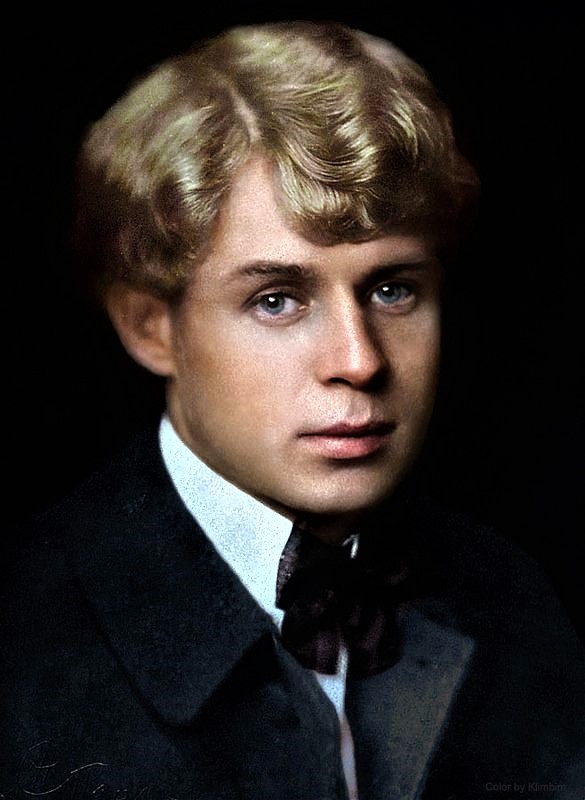
The Russian poet Sergei Yesenin (1895 – 1925) described himself as the „last peasant poet“. The inner conflict that characterises many of his poems, however, rather reflects life in the modern age and the big cities
Sergei Yesenin: Above the Night-black Field …
Above the night-black field
the cockerels‘ restless cry.
From his golden cloud
God looks down on us.
But in the blue discoloured plain
the wind rides in the tempestuous clouds,
tearing at the trembling poplars.
Haltlessly the fruits are tumbling.
Above the shivering pond
the longing flapping of the crane.
The bells have fallen silent
in the homeless house of autumn.
Whispering, the rivers still ride
across the valley with their herds.
But on the blood-stained hillside,
withered willows writhe.
How many songs are blown away!
How many have sunk into darkness!
Only in the dancing sparkle of the fireplace
can you find those who have disappeared.
Above the night-black field
the flitting fear of a fleeting mouse.
Mute remembrance of the dead.
But amidst the indestructible roots
the divine moon silently weaves
the tapestry of a new time.
Сергей Есенин: Нощь и поле, и крик петухов (1917)
CONTENT
The „last peasant poet“ as a successful metropolitan poet
Restless travelling „scandal poet“
Returning home to a foreign land
Bloody farewell
St. Petersburg (Leningrad), 28th December, 1925: In Room No. 5 of the Hotel „Angleterre“ (England), the Russian poet Sergei Yesenin inflicts a bleeding wound on himself with a razor blade. He dips his pen into the blood and writes a few farewell verses. Then, at the age of thirty, he hangs himself from a heating pipe.
Not a nice death – and yet one that somehow corresponds to the inwardly torn life of this poet.
The „last peasant poet“ as a successful metropolitan poet
Born on 3rd October 1895 in the village of Konstantinovo near Ryazan, Yesenin grew up with his grandparents. As early as 1912, he went to Moscow, where he first tried his hand in the world of bookselling and at the university. After moving to St. Petersburg in 1915, he published his first volume of poetry the following year, which established his early fame.
There are at least three reasons why Yesenin became a celebrated poet so quickly:
First, Yesenin touched the hearts of his audience with his melancholic nature poetry.
Secondly, his delicate figure came very close to the cliché of a sensitive poet. This appealed especially to his female audience. Even the Tsar’s wife invited him for private readings. Yesenin was not at all displeased that women’s hearts flew to him. In addition to numerous liaisons, he was married no less than four times in his short life.
Thirdly, Yesenin struck a nerve with the image he created of himself. By stylising himself as the „last peasant poet“ (1), he met the nostalgic longing of the metropolitan public for the supposedly ideal country life. This was particularly strong in Russia, which set out late and thus very abruptly on the path to the industrial age.

The poet and the revolution
As a self-proclaimed „peasant poet“, Yesenin was at first sight a natural ally of the Workers‘ and Peasants‘ State that was proclaimed after the October Revolution.
In fact, the poet initially welcomed the revolution. However, his romanticised image of rural life had little to do with the ideas of the new rulers.
Instead of helping the people in the countryside to lead a more self-determined life and achieve greater prosperity, as Yesenin had hoped, the overthrow had exactly the opposite effect. In the revolutionaries‘ understanding, peasant labour was first of all the foundation on which the industrialisation of the country was to be built. The forced collectivisations that were ordered in agriculture for this purpose resulted in famines and a further restriction of peasant self-determination.
In addition, the new model of art was diametrically opposed to Yesenin’s ideals. Socialist realism, Agitprop and Proletkult were the opposite of what Yesenin wanted to express with his contemplative nature poetry. Consequently, he condemned the directives of the new cultural bureaucracy as a „war that has been declared on active art“ (2).
As a result, Yesenin became for the new rulers the epitome of the subjectivist artist who did not fit the requirements of the new era. In 1927, Nikolai Bukharin even declared „Yeseninshchina“ to be the „most dangerous phenomenon“ in literature (3).
Reflexivity and sensitivity were no longer in demand. Instead, an art was propagated that provided positive role models and identification figures for the construction of the socialist state. Self-doubt and critical thinking were to take a back seat to unquestioning obedience to the path laid down by the party leaders.
„I am tired of my homeland“
Given this situation, a large part of the Russian avant-garde soon turned their backs on the revolution. Many emigrated – in Berlin, a veritable exile colony of Russian artists emerged (4). Yesenin, too, sought distance from the revolutionary establishment, but remained at home and set out on extensive journeys to the Asian part of the Soviet Union. These took him to the Urals, Tashkent and Samarkand in 1921.
In retrospect, we can probably say: this was the beginning of the end. For Yesenin, who in his poems always associated his attachment to nature with his rootedness in his homeland, was not made for the life of a restless traveller. He needed the support of a fixed place and a stable environment.
If we take him at his word, he was basically lost the moment he set out from his home village. So Yesenin wrote as early as 1916, before the October Revolution:
„I am tired of my homeland,
of the painful longing for buckwheat widths.
I want to leave my peasant cottage
and steal myself away, roaming the world.“ (5)
Two years later, leaving the home village turns into a swan song to the native country:
„I have left my home,
the blue skies of my native land.
(….)
For a long, long time I will not return,
singing my songs in the flurry of snow.“ (6)
Spiritual homelessness
Written by a poet in his early 20s, these verses can of course also be related to the farewell to childhood in general. After all, the lost paradise of childhood is also perceived and described by other poets in the mirror of their homeland.
The intensity with which Yesenin turns to the subject again and again (7), however, shows that the farewell to his home village has a deeper meaning for him. Consciously or unconsciously, he associates it with the painful departure into modernity and the associated loss of the straightforward structures of pre-modern times.
This departure may be unavoidable and is consequently longed for downright by the poet. However, it is precisely from this that the existential homelessness results: the old suit no longer fits, but neither does the new one. Thus, in retrospect, the rural homeland becomes a symbol for a – irretrievably lost – life in harmony with oneself and nature. Yet for Yesenin, this was precisely the prerequisite for his creativity.
The destruction of the peasant environment through mechanisation and forced collectivisation therefore does not simply appear in the poet’s eyes as an intervention in his concrete homeland. Rather, it deprives him of the spiritual basis of his life.
The confession of being the „last peasant poet“ is hence already a foreshadowing of his own early death. Indeed, the corresponding poem from 1920 explicitly states that the „songs“ of the peasant poet would have no chance of survival among the spiritually dead („not alive“), „alien hands“ of the new age. Thus the poet is condemned to become a martyr to his own writing:
„The candle of my body consumes itself
with a golden flame.“ (8)
Restless travelling „scandal poet“
Yesenin’s inner turmoil became even worse after he had married the dancer Isadora Duncan, 18 years his senior, in 1922. Perhaps Yesenin had unconsciously promised himself new stability from the marriage, new comfort through the attachment to a maternal figure. The tours through Europe and the USA on which he accompanied the famous artist, however, had the opposite effect.
The poet, who had not been averse to alcohol even before, now indulged in veritable alcoholic excesses. As the popular diva’s companion, he attracted attention not for his poetic talent, but as a self-confessed „scandal poet“ (9), who regularly reduced the furniture of the hotel rooms to rubble. Thus the marriage broke up just one year later.

Returning home to a foreign land
After his return to Moscow, Yesenin continued his restless life with endless drinking tours in the bars of the capital. On the intellectual level, his volatility was reflected in the proclamation of ever new poetic programmes as well as in the alternate forming and breaking of alliances with other literary figures. Of course, he did not make friends in this way.
A final anchor for his life seemed to emerge in October 1925, when Yesenin married Sofia Tolstaya, Lev Tolstoy’s granddaughter. Here, too, he might have unconsciously hoped that the spirit of the morally strict grandfather could somehow affect his life and thus help him get his feet back on solid ground.
But this hope was not fulfilled either. Only four weeks after the wedding, his new wife had Yesenin admitted to a psychiatric clinic. This was the last step before his suicide at the end of the same year.
Ostracised by Stalinist propaganda, Yesenin’s poetry nevertheless remained alive among the people. When his works were republished after Stalin’s death, a million advance orders were immediately placed (10). Today Yesenin is one of Russia’s most popular poets.

Video 1918:
References
- Adaptation from Я последний поэт деревни (I am the last peasant poet, 1920).
- Quoted according to Braun, Michael: Dichter des russischen Aufruhrs (Poet of Russian Revolt); taz, June 18, 1992 [Review of Fritz Mierau: Sergej Jessenin. Eine Biographie. Leipzig 1992: Reclam].
- Cf. ibid.
- Cf. the anthology by Mierau, Fritz (ed.): Russen in Berlin. Literatur, Malerei, Theater, Film 1918 – 1933 [Russian Artists in Berlin. Literature, Painting, Theatre, Film 1918 – 1933]. With comments by the editor and 113 documentary illustrations. Leipzig 1987: Reclam.
- Adaptation from Устал я жить в родном краю (I am tired of living in my homeland; 1916).
- Adaptation Я покинул родимый дом (1918); full poem with English translation (by Valeriu Raut) on lyricstranslate: I have left my endeared home.
- Cf. Yesenin’s poems on the subject Родина/Homeland (Стихи о родине Сергея Есенина) listed on culture.ru.
- Adaptation from: Я последний поэт деревни (I am the last peasant poet, 1920); second strophe, verse 1 and 2.
- Yesenin, self-description, quoted according to Braun (see 2).
- Cf. Lüdke, Martin: Sergej Jessenin: „In meiner Heimat leb ich nicht mehr gern“ (Sergei Yesenin: „I don’t like living in my homeland any more“). Article as part of the „Frankfurter Anthologie“ in the Frankfurter Allgemeine Zeitung, updated on April 23, 2021.


Kommentar verfassen