

About the Poem Ich hân mîn lêhen (I Have My Fief) by Walther von der Vogelweide
In one of his poems, the medieval minstrel Walther von der Vogelweide celebrates the fundamental change in his life brought about by a fief granted to him by Emperor Frederick II. This sheds light on the living conditions of medieval minstrels.
I Have My Fief
I have my fief, let all the world know, I have my fief!
Now winter can no longer harm my toes,
the avarice of the high lords shall no more frighten me!
The king, charitable and noble, has taken care of me,
has bestowed upon me summer freshness and winter warmth.
Now my neighbour looks at me with pleasure
instead of seeing me as a spectre, as before.
For so long I had to suffer hardship without any fault of mine,
even my breath smelt of my ill repute!
Now the King has purified me, me and my songs.
German version (Middle High German and New High German)
Sung version byJoel Frederiksen with the Ensemble Phoenix Munich
Ideal Images of Minstrels
When we think of medieval minstrels today, we usually have a certain image in mind with which the poets in question have been portrayed in the various song manuscripts.
Of course, we know that these images are not realistic portraits. After all, the pictures were usually made long after the singers‘ deaths and have a purely illustrative function. And yet our idea of the minstrels‘ lives is at least distorted by them.
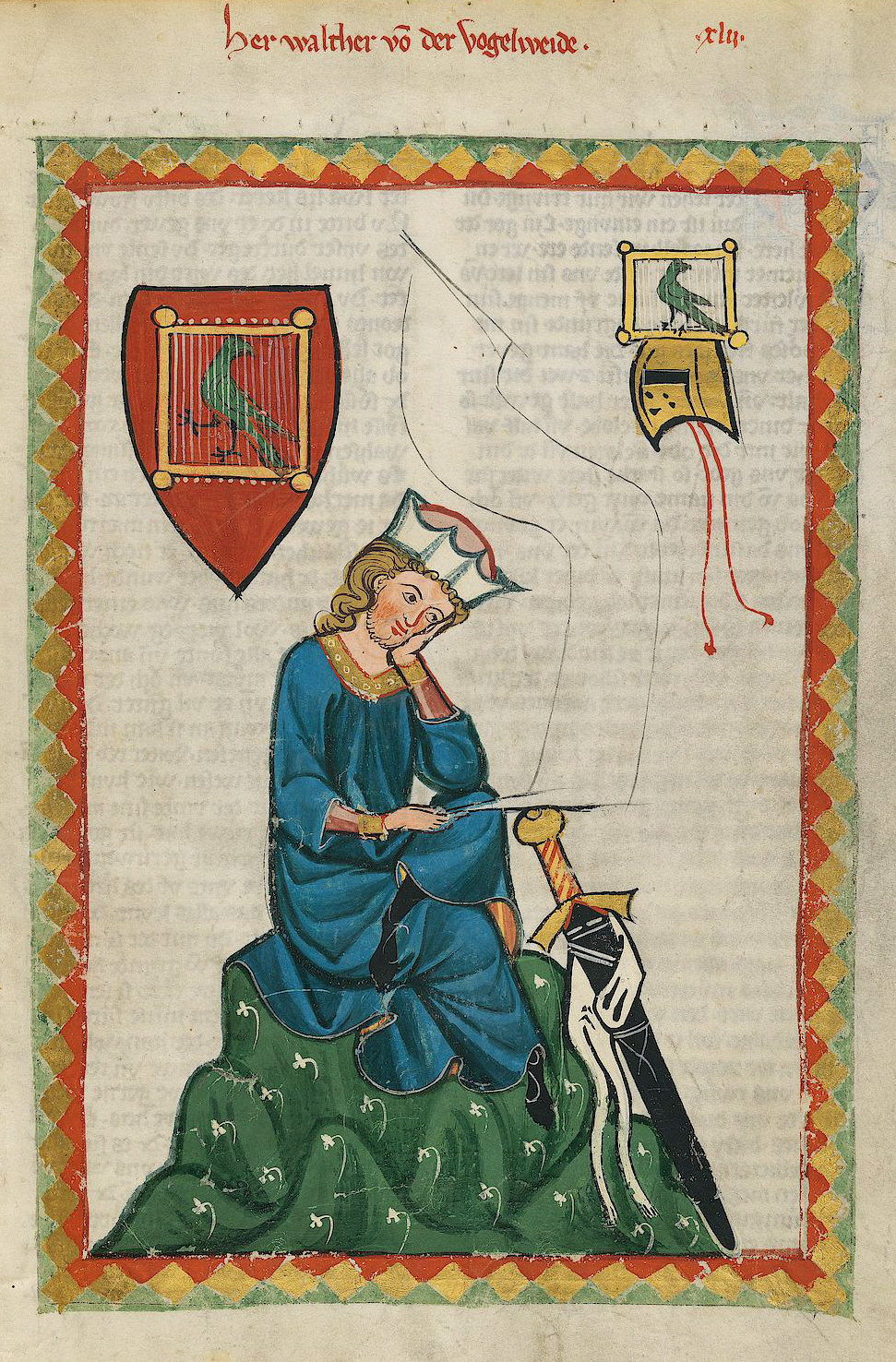
An example of this is the well-known image of Walther von der Vogelweide from the Manessian Song Manuscript („Manessische Liederhandschrift“). It was made at the beginning of the 14th century – but the famous minnesinger died in 1230 at the latest. Accordingly, the image is based less on the actual person than on Walther’s work and posthumous fame. The crown on his head praises him as a kind of „poet king“, and his posture alludes to one of his most famous poems, the so-called Reichsklage (Imperial Lament):
„Ich saz ûf eime steine,
und dahte bein mit beine;
dar ûf satzt ich den ellenbogen;
ich hete in mîne hant gesmogen
daz kinne und ein mîn wange.
dô dâhte ich mir vil ange,
wie man zer werlte solte leben (…)“
„With my legs crossed,
one elbow resting on my knee,
my chin and cheek
nestled in my hand –
that’s how I once sat, lost in thought.
on a rock and asked myself:
How shall I live in this world?“
The Reality of the Lives of Minstrels: The Example of Walther von der Vogelweide
The image of Walther in the Manessian Song Manuscript thus gives rise to the idea of a noble-minded, highly honoured philosopher-poet. This is also supported by the simple but at the same time preciously shimmering robe that the poet wears in the picture.
In the poem Ich hân mîn lêhen, though, the poet paints a completely different picture of his everyday life. It is true that Walther also uses poetic exaggeration to describe his appearance and the reaction of his fellow human beings to it. Nevertheless, the poem shows that during his lifetime Walther was by no means granted the undivided recognition of which his portrait in the Manessian Song Manuscript tells us.
This had a concrete effect on his living conditions. Tellingly, one of the few documents that have come down to us about Walther’s life is an excerpt from the expenditure book of the bishopric of Passau, Bavaria, where a gift of money for the purchase of a fur coat for the minnesinger is noted.
Dependence on the Charity of the High Lords
The monetary allowance sheds light on the reality of Walther’s life. As a poet-singer of at best lower nobility, he had no means of supporting himself. So he was dependent on finding a place for himself in the entourage of the various rulers with his songs.
In concrete terms, this meant: He had to sing praises of the potentates, who in turn filled his bowl with food and provided him with warm clothing and shelter for the winter. If he deviated from this line, if he expressed even slight criticism of the noble donors, he had to look for another court to earn a living as a break-time clown and festival singer.
But even when he had found such a shelter, his life was not exactly a rose garden. This is what he unmistakably hints at in the poem reproduced above. Not only was it humiliating for him to be constantly at the mercy of the high lords. Even their benevolence could not prevent others from recognising his humble origins by his appearance, and in winter he was not among the lucky ones who were allowed to sleep closer to the warmth-giving fireplace.
A Fief as a Gateway to a New Life
All this explains the euphoria with which Walther expresses his joy at receiving the fief from Emperor Frederick II in his poem written around 1220.
Regardless of whether the fief was a piece of land, an office or an annuity, it provided Walther with the security he had so painfully missed before. The fief gave him a different position in society. It increased his prestige, but also implied the prospect of more regular income and thus the end of the humiliating beggar-singing.
If Walther ever sang the poem himself, we can assume that he would have adopted a lighter, more cheerful tone for it. If courtly etiquette had allowed him to do so, he might even have resorted to the louder wind instruments of popular festivities (such as shawms and bagpipes) – because these would have been far more suitable for expressing his joyful excitement.
But apart from the fact that it is much easier to accompany oneself musically with lute and harp, such performance practices were not in keeping with the courtly customs of the time. Thus Walther may indeed have sung the poem – if at all – rather in the subdued tone in which Joel Frederiksen performs it in a recording with the Ensemble Phoenix Munich (see above).
Image: Picture of Walther von der Vogelweide in the Manessian Song Manuscript (Manessische Liederhandschrift); between 1305 and 1315 (Wikimedia Commons)

 Planet Literature
Hinterlasse einen Kommentar