

Habib Koité: Africa
n his song Africa, Malian singer-songwriter Habib Koité encourages his compatriots to rather trust in their own cultural and material resources instead of depending on Western aid.
Africa
The sons of Africa wanted to go for a walk.
Far, far they went,
to the borders of the continent,
where they had learned
how things work elsewhere.
On our continent, we were used to welcome
the whole world in our home
with our innate sense of hospitality,
our natural dignity and nobility.
But when we were about to cross the threshold
to the world of the others,
we were told at the border
in Ceuta [at the Strait of Gibraltar]:
„Sorry, but your innate sense of hospitality
does not exist here!“
So the sons of Africa returned home,
following the saying:
„Better an unattractive woman than an empty room!“
True, they had heard of the precious gifts
from those on the other side of the border.
But for the time being, they were fed up
with the empty promises.
// Help … Help … No more aid for Africa! //
Africa: condemned to poverty!
Africa: doomed to corruption!
Africa: a swamp of corrupt elites!
Africa: wars and genocides!
The United Nations have decided:
Poverty is to be fought.
The AIDS epidemic is to be fought.
Child mortality is to be fought.
Mama Africa’s own wealth is to be fought.
// Aid … Aid … No more aid for Africa! //
The utopia of justice …
Aid … No more aid for Africa!
Solidarity …
Aid … No more aid for Africa!
The illusion is deceptive, but dreaming is allowed!
No more aid for Africa!
Africa will find its way somehow.
No more aid for Africa!
My pride as an African is called: Mambo!
No more aid for Africa!
We are all in the same boat!
No more aid for Africa!
Africa will find its way somehow …
Habib Koité with the and Bamada: Africa (sung in Bambara up to the chorus, then in French) from: Afriki (2007; full album available on Bandcamp)
Unplugged version with Vusi Mahlasela
Western Charity? – No, Thanks!
During the Christmas season, numerous fundraising campaigns once again focus on the poor and needy of this world. Particularly often, people in Africa are the objects of the Christmas surge of mercy.
But the question is: Do they want our mercy in Africa at all? Do they want to be an object of our charity, a mirror for the God-pleasing Western world?
In the song Africa by Habib Koité and his band Bamada, which addresses the problems of the continent from an internal perspective, the answer is quite clearly: No!
Commitment to Africa’s Own Roots
The song by Koitè – an artist born in 1958 in Senegal who lives in Bamako, Mali – would undoubtedly be considered racist if sung by a European. For the mantra-like repeated core message is: „Assez aidé Africa!“ („Africa has been given enough aid.“) The commitment to a „fierté nègre“, a „black pride“ that manifests itself in the „mambo – a style of music and dance with African roots that originated in Cuba – also sounds like a pejorative stereotype to Western people.
However, uttered by an African, the words take on a different accentuation. The commitment to the mambo, which radiates spontaneity and joie de vivre, then appears as an appeal to remain aware of Africa’s original cultural roots and to be guided by them in the development and transformation of African societies. In the song, this appeal arises directly from the rejection of European culture and its xenophobia, which is contrasted with Africa’s „innate“ hospitality.
The High Cost of Western Aid
Against this backdrop, aid from Europeans and the rest of the world to the African continent is also viewed critically. The song admits that it helps fight poverty, child mortality and disease epidemics. However, according to the criticism in the song, this must be paid for by „Mama Africa“ through giving up everything that she brings forth from herself. This can be related to the autochthonous cultures as well as to the raw materials whose exploitation is in fact the unquestioned compensation for the aid.
In view of the patronising nature of this kind of assistance, the song pleads for doing without it. Koité does not hide the fact that many African problems are homemade: The African governments drowning in the „quicksand“ of their greed, the wars and the genocides show that the utopia of a solidary, socially just Africa is for the time being nothing more than a „deceptive illusion“.
In the resulting humanitarian disasters, Western aid is not only desirable but urgently needed. Thus, the scandal here does not consist in misunderstood or poorly organised aid, but in the fact that the aid organisations are granted too little financial resources by the international community and that these resources are often not disbursed on time or even not paid out at all.
Nevertheless, Koité pleads for holding on to the dream of a self-sustaining Africa. After all, the violence, hunger and social upheavals suffered by the continent’s countries are also closely linked to their relations with the wealthier part of the world.
The wars are fuelled by the arms factories of the industrialised nations, the enrichment of the corrupt elites would be unthinkable without the business partners in the West who engage in the lucrative relationships with them. And the social misery is based, at least in part, on the fact that exports to Africa hinder the development of an independent African industry and a corresponding labour market.
About Habib Koité
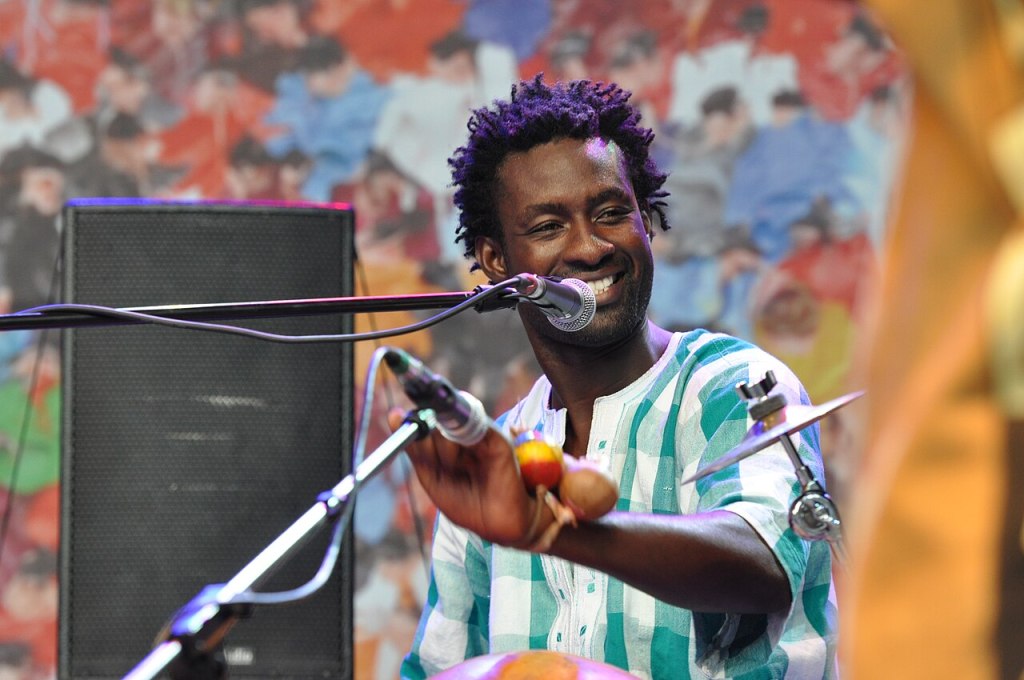
Habib Koité was born in Senegal in 1958. Since his father worked on the Dakar-Bamako railway line, the family moved to Mali one year after Koité’s birth. There he grew up as one of 18 children in an extended African family.
Among Koité’s ancestors are numerous „griots“ – African bards who perform at festivals and marketplaces, thus passing on the history and culture of their peoples to the listeners. In Koité’s family, this tradition was carried on by his mother, who accompanied Koité on the guitar from an early age. His exceptional musical talent prompted the family to let him study music at the art academy in Bamako.
Together with the band Bamada, founded in 1988, Koité started a career as a professional musician and soon became known beyond the borders of Mali. Koité’s songs can by no means be categorised solely as ethno-folk. Many of them are rather singer-songwriter pieces with ethno-musical elements. For these, Koité also repeatedly draws on non-African musical styles.
In some cases, however, Koité has consciously turned to the musical traditions of his Malian homeland and revived them in his works. In doing so, he has also endeavoured to build bridges between the different ethnic groups in Mali with his music.
This is especially true of Desert Blues, a joint project with a music group of Tuaregs, a nomadic people living in the north of Mali who have been involved in bloody conflicts with other ethnic groups time and again in the past. In 2006, the project inspired Michel Jaffrenou to make the film Jusqu’à Tombouctou („All the Way to Timbuktu“).
Images: Rapheal Nathaniel (Nigeria): Children on the street (Pixabay); Tom Beetz: Habib Koité ( Wikimedia)


Kommentar verfassen