

We all know that every autumn will eventually be followed by spring again. Yet there is something irreversible about the sense of doom in autumn. It reminds us of the fact that, while life itself recurs eternally, the form it once took disappears irretrievably.
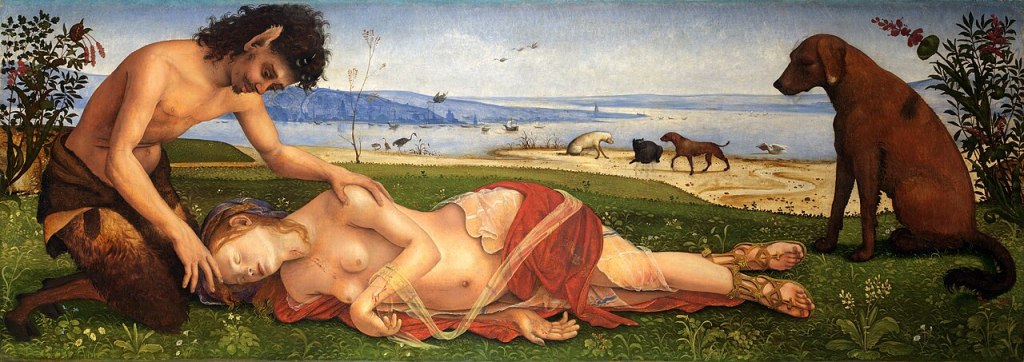
Pan in Autumn
When all that remains of the year’s daring journey
is but the wind’s lost lament –
a voice from the void, permeating the world –,
he often weeps with the rain for her,
who has painted the year in his heart.
For though he finds pleasure in all of the nymphs
of the glades, the meadows and brooks,
there is only one among them
who gently opens to him the summer night’s shrine
and shyly follows him into the rapturous dance.
They dance in the opening maw of the dark
and under the eagle’s majestic gaze.
They sing of the leap of the trout,
of the flight of a fawn and the dragonfly’s dawn
and attune to the hush of the dusk.
But then, in the withering woods and the fog
that envelops the world in a cloak of oblivion,
when in desperate rage the winter crows
shatter the world into splinters of ice,
they too will succumb to November’s whims.
And in the vanishing breath of the year,
they suddenly find themselves facing
the funeral mask of their love.
And so she merges once more with the murmur
of branches and brooks, while he is engulfed by the dark.
Certainly he is aware of the blossoming paths,
where one day he will yield to another nymph’s charms.
Yet he knows that no other compares to the one
he misses – and so he listens for her in the rain,
which carries her whispering voice to his ear.
Image: Piero di Cosimo (1462 – 1522): The Death of Procris (who, according to Greek mythology, was killed by her husband in a hunting accident and who herself owned an immortal hunting dog); alternative title of the painting: Satyr mourning a nymph (um 1495); London, National Gallery (Wikimedia commons)


Kommentar verfassen