

Excerpts from Rothilda von Rotortod’s Novel Overturned – How Aliens Tried to Conquer the World with Wind Turbines/5
The leader of the Earth exploration mission is back visiting his home planet. He goes on an outing and reflects on how the different living conditions on his planet and on Earth influence people’s attitudes to life.
About the Novel
After the invention of a rejuvenation pill, space and resources threaten to become scarce on planet Kadohan. The only way out is the search for a replacement planet. The choice is made for the planet „Earth“. Unfortunately, however, this planet is already inhabited …
An Excursion on Kadohan
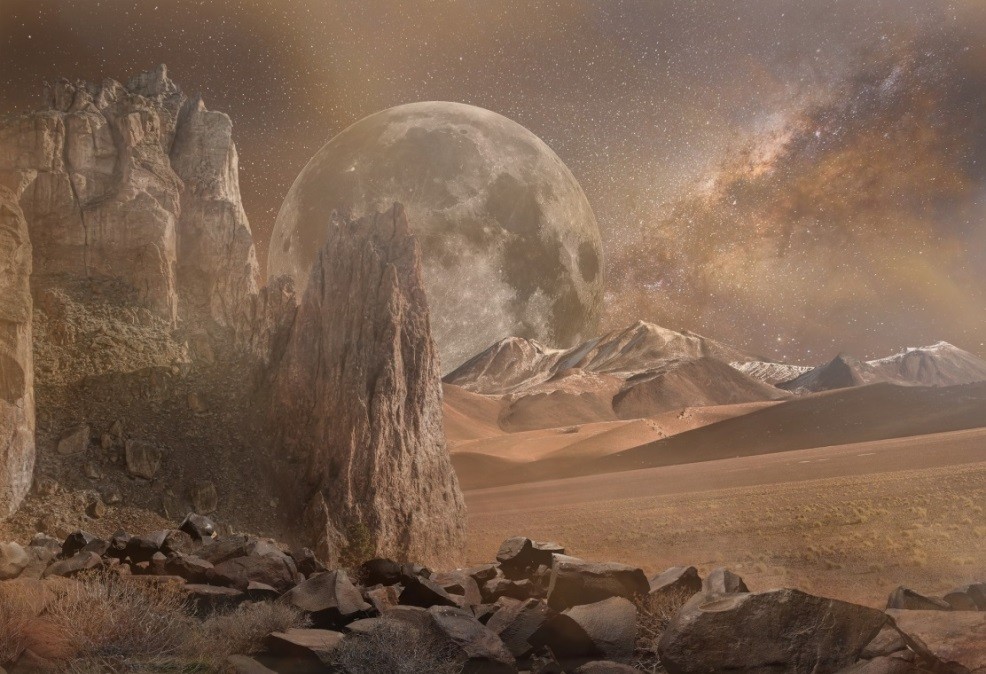
The space glider gently touched down on the desert floor. The expedition leader opened the hatch and jumped into the warm sand.
He had not gone on such an excursion for a long time. During the last visits to his home planet his schedule had always been far too packed. So he had constantly been rushing from one meeting to the next under the plasma roof of the big tent city. This time, however, he wanted to immerse himself again into the atmosphere that had enveloped him since childhood.
Just at the moment of his landing, one of the two Kadohanian days was coming to an end. Slowly the Merza sun approached the horizon. The magic wand of its oblique light transformed the barren landscape into a sea of bizarre flowers.
The Light of the Merza Sun
In their purple dress of rays, the rocks mutated into calyxes, from which a violet pollen rained up to the sky. Once there, it merged with the stardust to form a shimmering cloud, which covered things as a transparent veil. Nothing remained what it was. The things slipped out of their shells, they opened like buds kissed by the light and revealed the dream of their being.
But then the blossoms became gemstones, the gemstones turned into the battlements of sandcastles, and the sandcastles disintegrated into a cloud of dust that was swallowed up by the fading purple cloak of light. In the end, the expedition leader found himself surrounded again by the same shapeless rocks that rose from an extinct sea of sand. Solidified waves rippled over the surface. All paths led to nowhere, the writing had fallen silent.
The Rise of the Siya Sun
What was beautiful about the days on Kadohan, however, was that every ending immediately gave way to a new beginning. The vespertine crown of thorns merged seamlessly into the floral wreath of the morning. As soon as the last drop of light emitted by Merza had seeped into the sand, a gate opened up in the clouds on the other side of the sky, and Siya, the second sun of Kadohan, took up the reins.
The expedition leader only had to turn around to pass from one magical world to the other. Blinded by the abundance of light, he saw glittering fishes swimming through the morning, flanked by a herd of underwater horses on either side of the shoal. Exuberantly they frolicked over the shimmering hills of clouds. Sparks flew from their hooves to the Earth and set fire to the sand, which, stirred up by the wind, wound their way up towards the sky as columns of flame.
The expedition leader let his gaze wander across the glistening plain, from which the flickering curls of the grass tufts shone out like stranded comets. In the far distance, where the horizon was lost in space, he dropped anchor at the dreamed silhouette of a mountain.
The Truth of the Cosmos
The left half of the expedition leader’s face twitched: his feelings were in turmoil. Yes, he said to himself, that’s what it means to feel at home. What he sensed intensely again during his little excursion was exactly the basic mood on Kadohan: a feeling of all-embracing shelter. Life here was like that of a child whose mother never slept and was always there for her dear ones.
How different was life on Earth, where people were regularly cut off from the nourishing power of light – in some places even for several months! Often he had felt hopelessly lost there – like a child abandoned by his mother in a dark forest, without knowing whether she will come back again.
On the other hand, the expedition leader asked himself: Didn’t this reflect the cosmic cycle much better than the sheltered life on Kadohan? Didn’t the nights on Earth convey a much more intense impression of the reality of life, this rushing of a speck of dust through an inflated void?
Of course, the telescopes circling around Kadohan provided him with countless perspectives of the starry world, which he could access at any time with the help of his simulation mask. But this artificial contact with the cosmos was quite different from the immediate immersion in it, as was the case during the nights on Earth.
Admittedly, with their light-flooded cities and their thick walls behind which they entrenched themselves, the Earthlings did everything they could to avoid such an experience. Nevertheless, their planet – unlike Kadohan – at least offered the conditions for it.
The Earthly Rhythm as an Analogy to the Cosmic Rhythm of Life
It was no different with the vegetative rhythm of life on Earth. On Kadohan, thanks to the atmosphere control system, they were largely independent of natural fluctuations. Although this was very convenient and allowed reliable planning for the future, it had the disadvantage that the days flowed by in monotonous uniformity.
On Earth, it was exactly the other way around. True, the Earthlings also tried their best to control their environment and to influence it in their own way. But even if their technical and prognostic possibilities should eventually reach the level of the Kadohanian civilisation – some things they would not be able to influence even with the most sophisticated manipulation techniques.
The seasons, the awakening and dying of vegetation, which in some regions were interwoven in an incessant feverish dream – all these things were inseparable from the essence of this planet. And couldn’t this too be understood as a parable for the cosmic becoming and passing away? Wasn’t this another aspect of the Earthlings being closer to the cosmic cycle than the Kadohanians in their world wrapped in the light cocoon of two suns?
The Difficulties Associated with an Artificially Optimised Everyday Life
The longer he lived on Earth, the more the expedition leader feared that the uniqueness of this planet could be lost by the planned invasion.
Of course, the seasons and the day-night rhythm would have been untouchable even for the Kadohanians. But what if the essence of the planet was to be pushed even further into the background by them than it already was now, due to the Earthlings‘ behaviour? What if plasma tent cities were to grow out of the ground everywhere on Earth, cities from which the seasons would be locked out and in which light intensity, temperature, humidity and all the other atmospheric parameters would be automatically controlled, precisely tailored to the needs of the inhabitants?
It was undeniable that the Earthlings were not to be envied for their short life, a life constantly threatened by all kinds of unforeseeable dangers. The expedition leader knew very well that he wouldn’t have traded places with them, even if he had the choice. On the other hand, life on Earth had also made him aware of the disadvantages and risks associated with the artificially optimised life on Kadohan.
Increased Intensity of Life on Earth
The intensity of life, for example, was much greater on Earth. Could it be, he kept asking himself, that in the end the same energy was available for every single being – so that it was just consumed much more slowly during a longer life span, which in turn went hand in hand with a less intensive way of life?
And didn’t the mere awareness that one’s own life could be over tomorrow lead to a heightened sense of existence? To the desire to savour every second to the full, with every single moment coming much closer to eternity than the seemingly endless life of the Kadohanians?
Furthermore, the completely optimised everyday life on Kadohan was linked to a feeling of total control over the planet. But this feeling was, as the expedition leader knew, an illusion. A dangerous illusion, considering how easily the fragile balance of the two suns, which held Kadohan in their midst as if in a cradle, could be shattered.
In the event of a major asteroid impact, they would have been just as powerless on Kadohan as on other planets. But the less aware they were of the fragility of their livelihoods, the greater was the danger of destroying them through carelessness.
from: Rothilda von Rotortod: Overturned (PDF and ebook):
Image: Karl Frey: Fantasy (Pixabay)


Kommentar verfassen